For many salaried people, the month has a familiar shape: salary arrives, bills go out, the first two weeks feel comfortable, and the last week is tight. Managing your salary is not about earning more first. It is about a simple order of operations that you repeat every month. This guide gives you that order, a worked example for a ₹40,000 take-home salary, and the habits that make it stick.
Step 1: Know your take-home salary
Use the amount that actually reaches your bank account after tax, provident fund and other deductions — not your CTC. If you get variable pay, bonuses or incentives, leave them out of the monthly plan and decide separately what to do with them when they arrive.
Step 2: Pay yourself first
On salary day, before anything else, move your savings to a separate account or investment. A common target is 20% of take-home pay. If that is not possible yet, start with 10% — or even 5% — and raise it with each increment. Saving first works because it removes the decision. Saving "whatever is left" rarely works, because there is rarely anything left.
Step 3: Pay fixed bills
Next, cover everything that is the same every month:
- Rent or home loan EMI
- Other EMIs
- Electricity, gas, internet and mobile
- Insurance premiums (monthly share)
- School fees, maid and other fixed payments
See fixed vs variable expenses for how to build this list.
Step 4: Plan variable spending
What remains is for groceries, milk, vegetables, transport, eating out, shopping and everything else. Give each a monthly limit based on what you really spend, then divide the total by four or five to get a weekly limit. A weekly limit stops the "first two weeks" problem.
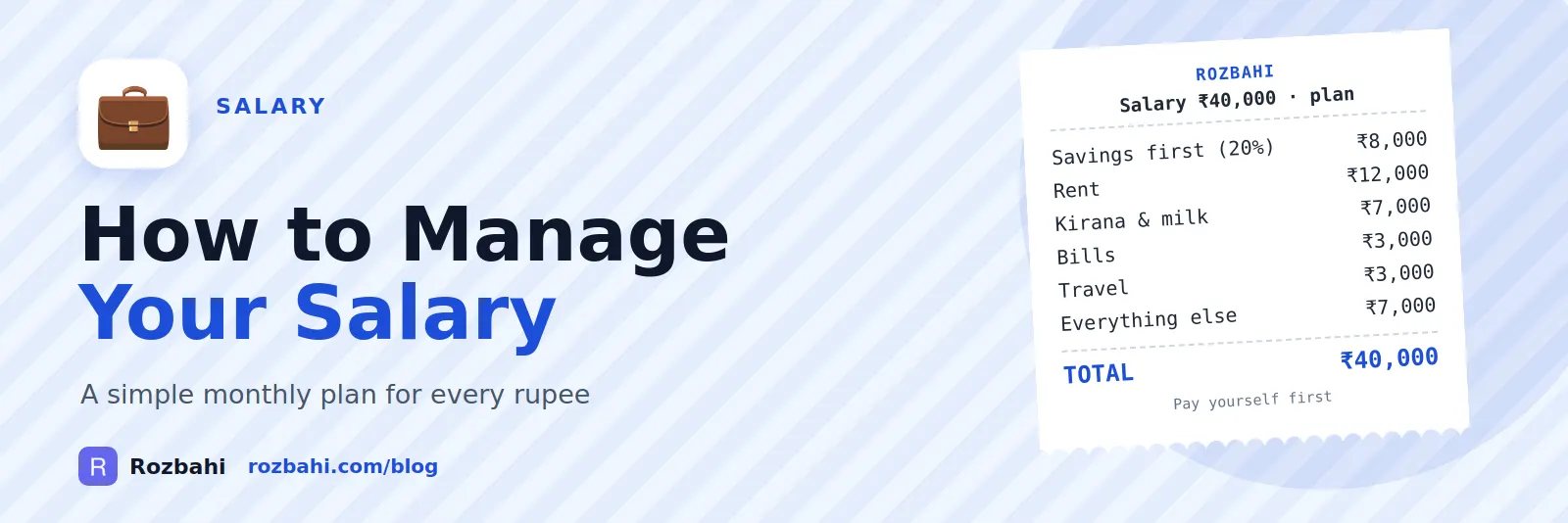
A worked example: ₹40,000 take-home
- Savings first (20%): ₹8,000
- Rent: ₹12,000
- Kirana and milk: ₹7,000
- Bills (electricity, gas, internet, mobile): ₹3,000
- Travel: ₹3,000
- Everything else (eating out, shopping, personal, small surprises): ₹7,000
Total: ₹40,000. Variable spending other than kirana — travel and everything else — is ₹10,000, or about ₹2,500 a week.
Step 5: Track every expense
A plan only works if you know where you stand. Record each spend as it happens — it takes seconds — and check once a week. Our guide on how to track daily expenses makes it a habit, and tracking UPI payments covers the small scans that add up.
Step 6: Build an emergency fund
Part of your savings should build an emergency fund of three to six months of essential costs, kept separately. It is what stops a medical bill or a job change from becoming credit card debt. See how much emergency fund you need.
Step 7: Plan the big months
Festivals, weddings, school admissions, insurance renewals and travel come every year. Add up their yearly cost, divide by 12, and set that amount aside monthly. Our Diwali budget guide shows how this works for the biggest festival month.
What to do with increments and bonuses
- Increment: raise your savings by at least half the increase before lifestyle catches up.
- Bonus: split it — for example, part to the emergency fund or loan prepayment, part to goals, and a small part to enjoy.
- Tax refunds and arrears: treat them like a bonus, not like salary.
Common salary management mistakes
- Planning on CTC instead of take-home pay.
- Saving at month end instead of salary day.
- No weekly limit, so the first fortnight takes most of the money.
- Too many EMIs. A useful rule of thumb is to keep total EMIs well below a third of take-home pay.
- Using credit cards to stretch the month. If you need credit every month, the plan needs adjusting.
- Not tracking cash and UPI. Small payments are where plans quietly fail.
Managing salary as a couple or family
With two incomes, agree which costs are shared and how much each contributes, then apply the same steps to the household. See budgeting for couples and, for larger households, joint family expense sharing.
Three salary plans at different incomes
The same steps work at any income; only the numbers change.
- ₹25,000 take-home: savings ₹2,500 (10% to start), rent and bills ₹10,000, kirana and milk ₹5,500, travel ₹2,000, everything else ₹5,000.
- ₹60,000 take-home: savings ₹12,000 (20%), rent and EMIs ₹20,000, kirana and milk ₹9,000, bills ₹4,000, travel ₹4,000, everything else ₹11,000.
- ₹1,00,000 take-home: savings ₹25,000 or more (25%+), fixed costs ₹35,000, kirana and milk ₹12,000, bills ₹5,000, travel ₹6,000, everything else ₹17,000.
As income grows, the savings percentage should grow too — not just the spending.
Use separate accounts
A simple account structure makes the plan almost automatic:
- Salary account: where income arrives and fixed bills are paid.
- Savings account: where savings go on salary day; you do not use its card for daily spending.
- Spending: the remaining money for variable costs, ideally with a weekly check.
When savings never sit in the account you spend from, they are much harder to dip into.
A weekly 10-minute check
- How much of this week's variable limit is used?
- Did any category go over?
- What is coming up next week — a birthday, a trip, a bill?
- Is anything left to move to savings?
Ten minutes a week is the difference between a plan and a wish.
When there is not enough
If the plan does not balance, start with the big items: rent, EMIs and expensive habits. Small cuts help, but changing one large fixed cost — a cheaper home at renewal, prepaying a costly loan, dropping an expensive plan — often does more than dozens of small sacrifices. Track for a month first to see exactly where the money goes.
The bottom line
Savings on salary day, fixed bills next, a weekly limit for everything else, and ten minutes of review each week. Repeat it every month and your salary will start lasting the whole month — with something left over.
Start with this month: write it down, track it, and adjust next month based on what you learn.
How to do this in Rozbahi
- Record your salary as income in Rozbahi when it arrives.
- Put fixed bills on repeat — rent, EMIs, internet, school fees — so they are recorded on their due dates.
- Set monthly budgets for kirana, milk, transport, eating out and shopping, and watch the percentage used.
- Log every expense with quick add and templates, whether cash, UPI or card.
- Check the monthly report: total income, total spending, the balance left, spending by category and the change from last month.
- Create savings goals with a target and a deadline for the emergency fund and other plans.
Frequently asked questions
How should I divide my salary every month?
Savings first (around 20% if possible), then fixed bills, then weekly limits for variable spending. The 50/30/20 rule — needs, wants, savings — is a good starting guide; see the 50/30/20 rule.
How much of my salary should I save?
Aim for 20% of take-home pay. If that is not possible now, start smaller and increase it with every increment.
Why does my salary run out before month end?
Usually because savings are left for the end, there is no weekly limit, and small daily payments are not tracked.
Make this month's salary last: download Rozbahi.
Go deeper: Guide: how to make a monthly budget · Feature: budget planner · Feature: expense reports