Diwali is the biggest spending festival of the year for many Indian families. Sweets and dry fruits, gifts for family and staff, new clothes, diyas and lights, home cleaning and repairs, puja items, travel to relatives, and the famous festive sales — it all lands in a few weeks. Without a plan, the joy of Diwali is followed by a tight November and sometimes a credit card bill. With a simple Diwali budget, you can celebrate fully and still start the new month in control.
Step 1: List every Diwali cost
Start with last year. Look back at what you spent, or estimate category by category:
- Sweets and dry fruits — for home and for gifting
- Gifts — family, friends, colleagues, domestic staff, building staff
- Clothes — for the family
- Diyas, lights, rangoli and decor
- Cleaning, painting and repairs
- Puja items
- Travel — to parents or relatives
- Festive shopping — electronics, home items, gold, if planned
- Hosting — meals and snacks for guests
Step 2: Set a total and split it
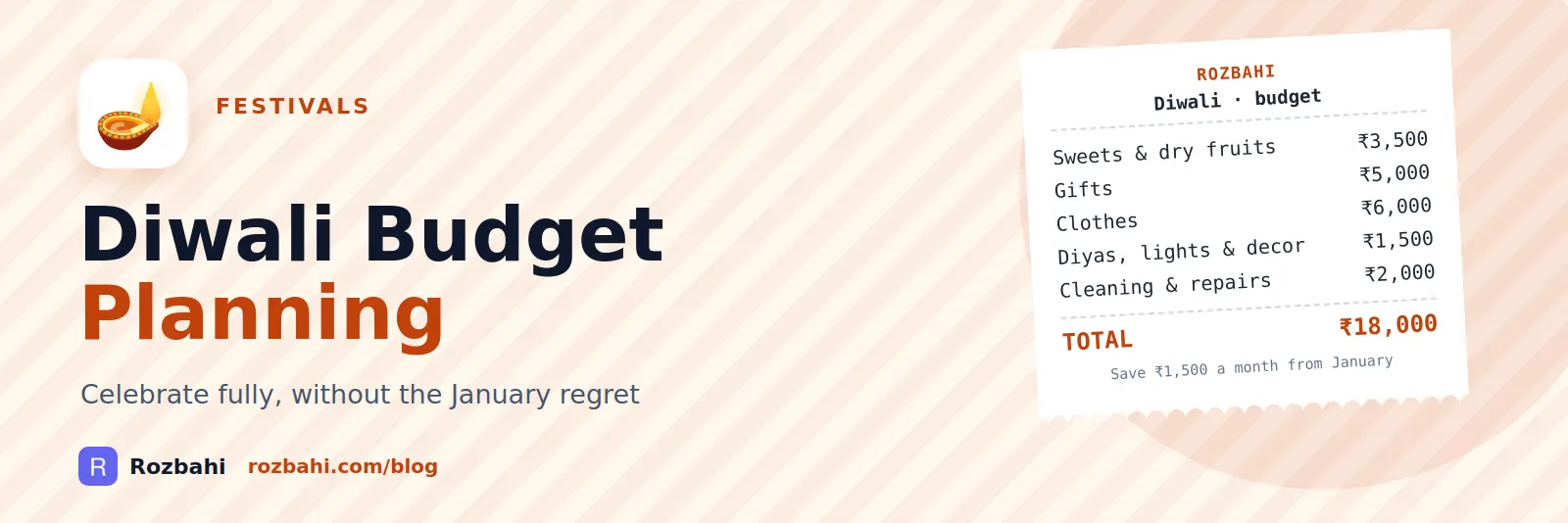
Decide one total you are comfortable with, then split it across the categories. An example Diwali budget:
- Sweets and dry fruits: ₹3,500
- Gifts: ₹5,000
- Clothes: ₹6,000
- Diyas, lights and decor: ₹1,500
- Cleaning and repairs: ₹2,000
Total: ₹18,000. Add travel and any big festive purchases separately, because they can be much larger than everything else together.
Step 3: Save for it all year
The easiest Diwali is the one already paid for. Divide your total by the months left until Diwali and set that amount aside each month in a separate savings pot. For an ₹18,000 Diwali, starting in January means saving ₹1,500 a month for twelve months. Start in June and it is about ₹3,600 a month for five months. The earlier you start, the smaller the monthly amount.
Step 4: Make a gift list
Gifts are where Diwali budgets most often break, because the list grows as the festival gets closer. Write the full list in advance with a fixed amount per person or group. Decide on bulk options — boxes of sweets or dry fruits — for staff and colleagues. Buy early, when choices are better and you are not rushing.
Step 5: Handle festive sales carefully
Festive sales are designed to make spending feel like saving. A few rules help:
- Make a list before the sale of things you genuinely planned to buy.
- Compare the price with a few weeks earlier; not every "sale" price is lower.
- Avoid no-cost EMI for things you did not plan. An EMI is still a monthly bill.
- Set a sale budget and stop when it is used.
Step 6: Track spending during the festival
During Diwali week, money moves quickly and in small amounts — a box of sweets here, a string of lights there, a tip, a gift. Record every Diwali expense as it happens, under a "Festivals" category, so you can see the running total against your budget. Check it every evening.
Step 7: Review after Diwali
When the festival is over, compare actual spending with the budget, category by category. Note what went over and why. That note becomes next year's budget, and next year's monthly saving amount. A Diwali that is reviewed is a Diwali that gets easier to plan every year.
Ways to celebrate well for less
- Make some sweets at home together as a family.
- Reuse decorations — store lights and rangoli items carefully after Diwali.
- Give thoughtful, smaller gifts instead of expensive ones.
- Plan cleaning and painting over a few weekends rather than paying for a rush job.
- Book travel early, when fares are lower.
The same method works for every festival
Holi, Eid, Christmas, Pongal, Onam, Durga Puja, weddings in the family — use the same steps: list, total, save monthly, track, review. Many families keep one "Festivals" savings pot for the whole year. See how to set savings goals.
A Diwali planning timeline
- January: set the Diwali total and start the monthly saving.
- August–September: make the gift list and decide on bulk gifts for staff and colleagues.
- Four weeks before: book travel if needed; plan cleaning and repairs; compare prices for planned purchases.
- Two weeks before: buy clothes and gifts; order sweets and dry fruits.
- Diwali week: track every purchase daily against the budget.
- After Diwali: review, note lessons, and restart the saving for next year.
Diwali for a joint family
In a joint family, several people often spend on the same festival: one buys sweets, another pays for lights, another for gifts. Without a shared record, the family's real Diwali cost is unknown and the same items get bought twice. Agree the budget together, decide who buys what, and record every purchase in one shared place. See joint family expense sharing.
Gifts for staff and helpers
Many families give Diwali bonuses or gifts to domestic help, drivers, watchmen and building staff. These are important and deserve a fixed line in the budget, decided early. A clear amount per person avoids last-minute stress and makes sure nobody is forgotten.
After Diwali: a gentle reset
The weeks after Diwali can feel tight even with a budget. Plan a simple November: fewer outings, home-cooked meals, and no big purchases. If the festival went over budget, cover it from the contingency or reduce next month's flexible spending, rather than carrying a card balance. Then start next year's Diwali saving straight away.
Track last year to plan this year
The most accurate Diwali budget comes from your own records. If you track this year's festival spending category by category, next year you will know exactly what sweets, gifts, clothes and decor really cost your family. Add a little for price increases and new commitments, and next year's budget is ready in minutes.
The bottom line
List every cost, set a total, save for it monthly from early in the year, make the gift list in advance, be careful with sales, track spending during the week and review afterwards. Diwali stays the joyful festival it should be — without a difficult November.
Start with this month: write it down, track it, and adjust next month based on what you learn.
How to do this in Rozbahi
- Create a savings goal in Rozbahi — "Diwali 2027", with your total and the date — and set aside the monthly amount.
- Add a "Festivals" category (त्योहार) for Diwali spending.
- Set a budget for it in the Diwali month and watch the percentage used.
- Log every purchase during the festival with quick add — sweets, gifts, lights, tips.
- Review after Diwali with the monthly report and compare with last year.
- Share with the family so everyone's Diwali spending counts in one place.
Frequently asked questions
How much should I spend on Diwali?
There is no fixed amount. Choose a total that does not need a loan or credit card debt, and save for it during the year.
How can I save money for Diwali?
Divide your Diwali budget by the months left and set that amount aside each month in a separate savings pot.
Are Diwali sales worth it?
For things you had already planned to buy, often yes. For unplanned purchases, a sale is still spending.
Plan next Diwali today: download Rozbahi.
Go deeper: Guide: how to make a monthly budget · Feature: budget planner