Ask any Indian household what they spend in a month and the first answer is usually a guess. Rent and school fees are remembered; the daily doodh, sabzi, chai, auto rides and small kirana top-ups are not. A complete monthly household expenses list is the first step to a realistic family budget. This guide gives you a checklist that fits most Indian homes, a sample month, and tips to keep the list accurate.
The complete household expenses checklist
1. Kirana (groceries)
- Atta, rice, dal, besan, suji, poha
- Oil and ghee
- Sugar, tea, coffee, salt, masale
- Biscuits, snacks, namkeen, breakfast items
- Cleaning: detergent, dishwash, phenyl, floor cleaner
- Toiletries: soap, shampoo, toothpaste
2. Doodh and dairy
- Daily milk (packet or loose)
- Curd, paneer, butter, ghee if bought separately
3. Sabzi and phal
- Daily or weekly vegetables
- Fruit
- Herbs, lemons, ginger, green chillies
4. Bills and utilities
- Electricity (bijli)
- Water
- Cooking gas cylinder or piped gas
- Internet and DTH or streaming
- Mobile recharges for every family member
- Society maintenance
5. Rent or EMI
- Rent (kiraya) or home loan EMI
- Other loan EMIs
6. Education
- School or college fees (monthly share of term fees)
- Tuition and coaching
- Books, stationery, uniforms
- School transport
7. Health
- Regular medicines
- Doctor visits and tests
- Health insurance premium (monthly share)
8. Transport and fuel
- Petrol or diesel
- Auto, cab, bus, metro
- Vehicle servicing and insurance (monthly share)
9. Help at home
- Maid, cook, driver
- Dhobi or ironing
- Newspaper and water cans
10. Eating out and entertainment
- Restaurants and food delivery
- Movies, outings, subscriptions
11. Festivals, functions and gifts
- Diwali, Holi, Eid, Christmas, Pongal and other festivals
- Weddings and shagun
- Birthdays and gifts
12. Personal and miscellaneous
- Clothes and shoes
- Salon and personal care
- Donations and religious offerings
- Repairs and household items
A sample month for a family of four
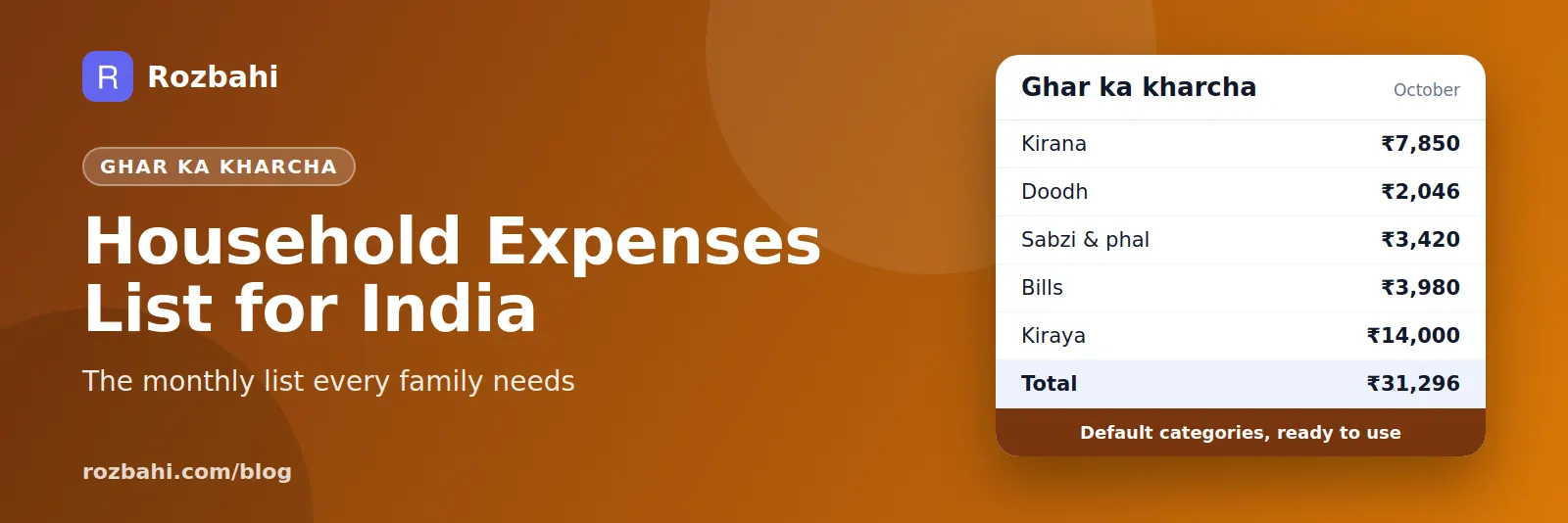
A family of four in a rented flat in a mid-sized city tracks one full month:
- Kiraya: ₹14,000
- Kirana: ₹7,850
- Sabzi and phal: ₹3,420
- Bills (bijli, gas, internet, mobile): ₹3,980
- Doodh: ₹2,046
These five essentials alone come to ₹31,296. On top of them come education, transport, help at home, health, eating out and festivals. Your numbers will differ by city and lifestyle; what matters is that every line is filled with real amounts, not guesses.
Monthly vs yearly costs
Some household costs do not come every month: school term fees, insurance, vehicle servicing, festivals. If you leave them out, normal months look affordable and the expensive months come as a shock. Add up the yearly total of these costs, divide by 12, and include that amount in your monthly list as a "planned extras" line. Set it aside each month so the money is ready when the bill arrives.
How to make your own list accurate
- Track one full month of every expense, including cash and small UPI payments. Our daily expense tracking guide makes this easy.
- Use the same categories every month so you can compare.
- Ask every family member what they paid for the household.
- Add yearly costs as a monthly share.
- Review after three months and update your list.
Turn the list into a budget
Once you know your real monthly household expenses, setting a budget is straightforward: keep fixed costs as they are, set limits slightly below your real spending for kirana, sabzi, eating out and shopping, and pay savings first. See our monthly household budget guide for the step-by-step method, and the milk bill calculator for getting the daily doodh hisab exact.
Ways Indian families commonly save
- Monthly kirana in one go from a wholesale or big store, and fewer top-ups.
- Seasonal sabzi from the weekly market.
- Annual plans for mobile and internet where they are cheaper.
- Checking the electricity bill in summer and using appliances more carefully.
- Planning festivals in advance instead of last-minute shopping.
छोटे खर्च, बड़ा असर
दिन में तीन बार ₹50 का नाश्ता या चाय — महीने में लगभग ₹4,500। ऐसे छोटे खर्च दिखते नहीं, लेकिन हिसाब में सबसे बड़ी बचत यहीं मिलती है। इसलिए शुरू के एक महीने में हर छोटा खर्च भी ज़रूर लिखें।
Expenses that are easy to forget
When families first make a list, these lines are often missing:
- Mobile recharges for every family member, not just one.
- Society maintenance and small building charges.
- Water cans and gas cylinders on irregular cycles.
- Tips and small payments to the watchman, delivery staff or garbage collection.
- Children's small costs: school projects, outings, birthday gifts for classmates.
- Medicines for parents paid by different family members.
- Shagun and gifts at weddings and functions.
- Religious offerings and donations.
Each is small, but together they can be several thousand rupees a month. Tracking for a full month is the only way to catch them all.
City vs town: how the list changes
The checklist is the same everywhere, but the weights differ. In big cities, rent, transport and help at home usually take a bigger share, and eating out and delivery are more common. In smaller towns, rent is often lower while family functions, festivals and travel to relatives can take a bigger share. That is why copying someone else's budget rarely works — your own list, filled with your own numbers, is what makes a budget realistic.
Joint families and shared households
In a joint family, expenses are often paid by several people: one brother pays electricity, another the kirana, the parents pay the milkman and the maid. A single list for the whole household, where each person adds what they paid, shows the real total. It also makes fair sharing easier, because everyone can see who contributed what. Keep personal spending separate and only put shared household costs on the common list.
Review the list every few months
Household expenses change: a child moves to a new school, rent goes up, a loan ends, prices rise. Every three months, compare your list with the last quarter and update any line that has changed. A list that matches real life is the basis of a budget that works.
How to do this in Rozbahi
- Start with ready-made categories in Rozbahi that match this list: Milk & Dairy, Groceries, Vegetables, Fruits, Bills & Utilities, Rent, Education, Health, Transport, Fuel, Food & Dining, Shopping, Entertainment and Other — in English or Hindi.
- Add your own categories, like "Help at home" or "Festivals".
- Set up recurring entries for rent, bills, school fees and daily milk.
- Share with the family through a family group so everyone's household spending is in one list.
- Read the monthly report to see your real household total by category and compare it with last month.
Frequently asked questions
What are the main monthly household expenses in India?
Rent or EMI, kirana, milk, vegetables and fruit, bills, education, health, transport, help at home, eating out, and a monthly share of festivals and yearly costs.
How do I calculate my monthly household expenses?
Track every household expense for one full month in fixed categories, include cash and UPI, and add a monthly share of yearly costs like fees and insurance.
How can an Indian family reduce monthly expenses?
Buy kirana monthly, sabzi weekly and seasonal, cut unused subscriptions, compare mobile and internet plans, and plan festival spending in advance.
Build your family's list: download Rozbahi.
Go deeper: Guide: how to make a monthly budget · Feature: budget planner