The 50/30/20 budget rule is the simplest budget most people will ever use. Take your monthly income after tax and split it three ways: about 50% for needs, 30% for wants and 20% for savings. No spreadsheets full of categories, no daily maths. It is a quick health check that tells you whether your spending is broadly in balance. This guide explains what goes in each bucket, shows real examples, and explains when to bend the rule.
The three buckets
Needs — 50%
Costs you must pay to live and work, and that would hurt to skip:
- Rent or home loan EMI
- Groceries, milk and vegetables
- Electricity, water, gas, internet, mobile
- Transport to work and school
- Insurance premiums and minimum loan payments
- School fees and essential medical costs
Wants — 30%
Spending that makes life better but could be cut if needed:
- Eating out and food delivery
- Shopping beyond basics, gadgets, clothes for fun
- Entertainment and streaming subscriptions
- Holidays and weekend trips
- Upgrades, like a bigger phone plan or premium brands
Savings — 20%
Money for your future self:
- Emergency fund (see how much emergency fund you need)
- Investments and retirement savings
- Savings goals: a home, a car, education, a holiday
- Extra payments on loans beyond the minimum
Worked examples
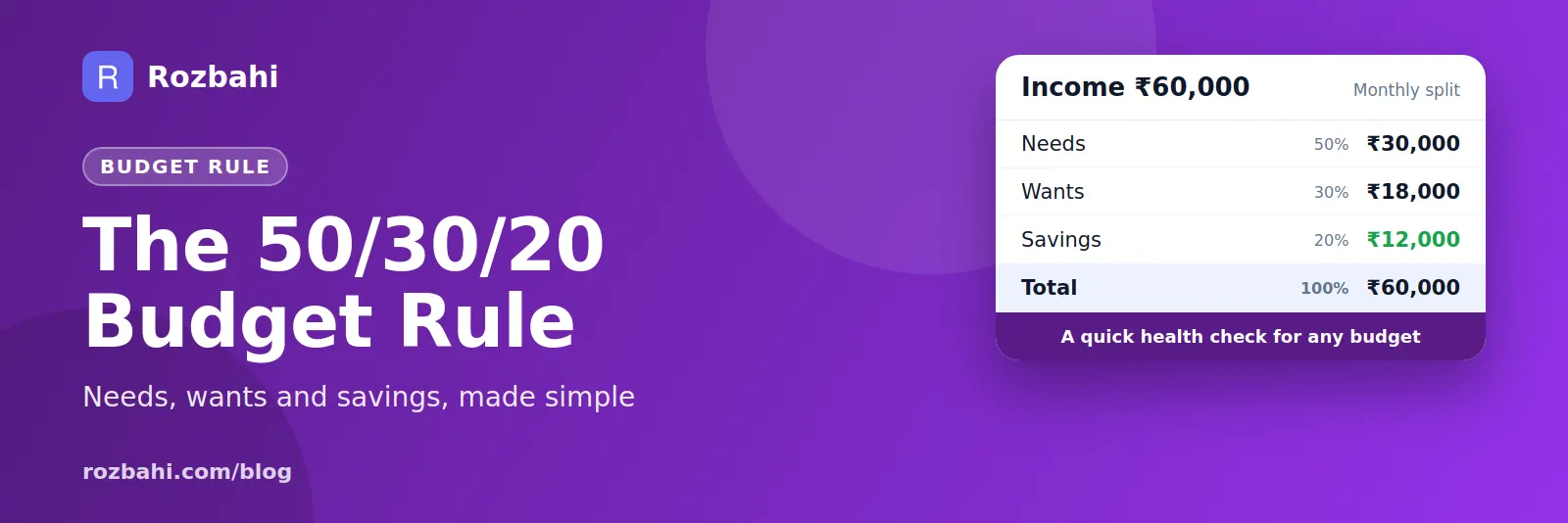
Take-home income ₹60,000 a month
- Needs (50%): ₹30,000 — rent ₹15,000, groceries and milk ₹8,000, bills ₹3,500, transport ₹3,500
- Wants (30%): ₹18,000 — dining out ₹5,000, shopping ₹6,000, entertainment ₹2,000, trips fund ₹5,000
- Savings (20%): ₹12,000 — emergency fund ₹6,000, investments ₹6,000
Take-home income $4,000 a month
- Needs (50%): $2,000 — rent, groceries, utilities, transport, insurance
- Wants (30%): $1,200 — dining, hobbies, travel, subscriptions
- Savings (20%): $800 — emergency fund, retirement, goals
The percentages work in any currency; the hard part is being honest about which bucket each expense belongs to.
Needs or wants? The grey areas
- Groceries: basic food is a need; premium brands and snacks are partly wants.
- Phone and internet: a basic plan is a need; the top plan is partly a want.
- Car: getting to work is a need; a more expensive car than necessary is partly a want.
- Clothes: replacing worn-out clothes is a need; new outfits for fun are wants.
A simple test: if you lost your income tomorrow, would you keep paying for it? If yes, it is a need.
When to adjust the rule
- High-rent cities: needs may be 60% or more. Accept it, cut wants to 20%, and keep savings at 20%.
- Paying off debt: use 50/20/30 — more to savings and debt, less to wants — until expensive debt is gone.
- Higher income: needs often fall below 50%. Push savings to 30% or more instead of letting wants grow.
- Irregular income: apply the rule to your lowest normal month, and save everything above it.
Common mistakes
- Using gross income. The rule uses take-home pay, after tax and deductions.
- Counting wants as needs to make the numbers fit.
- Saving what is left. Savings come first, on salary day; otherwise there is rarely anything left.
- Never checking. The rule only works if you know your real spending, which means tracking it.
From 50/30/20 to category budgets
The rule tells you the size of each bucket. To stay inside it day to day, break each bucket into a few category budgets: groceries, bills and transport inside needs; dining out and shopping inside wants. Our monthly household budget guide walks through it step by step.
How to calculate your 50/30/20 split
- Find your take-home income. Add up what actually arrives in your account each month, after tax, provident fund and other deductions.
- Multiply by 0.5, 0.3 and 0.2. These are your targets for needs, wants and savings.
- Add up last month's real spending in each bucket from your tracker.
- Compare. The gaps tell you where to act.
A real example: when the numbers do not fit
Priya takes home ₹75,000 a month. Her targets are ₹37,500 for needs, ₹22,500 for wants and ₹15,000 for savings. After tracking one month, her real split looks like this:
- Needs: ₹41,000 (55%) — rent alone is ₹22,000
- Wants: ₹27,500 (37%) — delivery and shopping are the biggest items
- Savings: ₹6,500 (9%) — whatever was left at month end
Rent is hard to change quickly, so she accepts needs at 55%. She cuts wants to 25% (₹18,750) by setting limits on delivery and shopping, and moves savings to 20% (₹15,000) by transferring it on salary day. The new split is 55/25/20 — not textbook, but a big improvement, and her savings more than double.
The rule works best with tracking
The 50/30/20 rule is only as good as your knowledge of where money goes. Most people underestimate wants, because they are made of many small purchases, and overestimate how much they save. One month of honest tracking usually changes the picture, and makes the rule practical instead of theoretical. Our guide on how to track daily expenses makes that month easy.
Other budget rules you may hear about
- 70/20/10: 70% spending, 20% savings, 10% debt or giving.
- 80/20: save 20% first and spend the rest freely. The simplest of all.
- Zero-based: give every rupee a job before the month starts.
All of them share the same core idea: decide your savings first, then spend within what is left.
Using 50/30/20 as a couple or family
For a household with two incomes, apply the rule to combined take-home pay for shared costs, and let each person keep their own wants within an agreed amount. Shared needs — rent, groceries, bills, school — come out of the 50%. Each partner gets a personal share of the 30% to spend freely, without having to explain every purchase. Savings goals for the family come from the 20%. This keeps the rule simple while respecting each person's independence.
Review the split together once a quarter, especially after a pay rise, a move or a new child.
Whatever split you land on, the habit that matters most is paying savings first, on the day income arrives. Everything else in the rule follows from that one decision.
How to do this in Rozbahi
- Track for a month in Rozbahi to see your real spending by category.
- Group your categories into needs (groceries, milk, vegetables, bills, rent, transport, fuel, health, education) and wants (food and dining, shopping, entertainment).
- Set category budgets so that needs add up to about half your income and wants to about 30%.
- Record your income as income entries; your monthly report shows total income, total spending and the balance, which is what you saved.
- Review monthly and move limits toward your target split.
Frequently asked questions
Is the 50/30/20 rule realistic?
For many people it is a good starting point. In expensive cities needs often take more than 50%; adjust the split, but try to protect the 20% for savings.
Does rent count as a need?
Yes. Housing is the biggest need for most people. If rent alone is over 40% of take-home pay, needs will be hard to keep at 50%.
Should debt payments be in needs or savings?
Minimum payments are needs. Anything extra you pay to clear debt faster can come from the savings bucket.
See your real split: download Rozbahi and track one month.
Go deeper: Guide: how to make a monthly budget · Feature: budget planner