
Money is one of the most common sources of tension between partners, and it is rarely about the amounts. It is about expectations: who pays for what, how much freedom each person has, and what "fair" means when incomes differ. Budgeting for couples is less about spreadsheets and more about agreeing a simple system you both trust. This guide covers the main options, how to split shared costs fairly, and how to keep money conversations calm.
Three ways couples manage money
1. Fully joint
All income goes into one shared pool, and everything is paid from it.
- Good for: couples with similar spending habits and full trust in each other's choices.
- Watch out for: a feeling of having to justify every personal purchase.
2. Fully separate
Each person keeps their own money, and shared costs are split.
- Good for: new relationships, very different spending styles, or second marriages with existing commitments.
- Watch out for: constant small calculations and a "my money, your money" feeling.
3. Hybrid ("yours, mine and ours")
Each person contributes to shared costs and keeps the rest.
- Good for: most couples. Shared costs are shared; personal spending stays personal.
- Watch out for: agreeing clearly what counts as shared.
What counts as shared?
Write the list together. Usually shared:
- Rent or home loan, utilities, internet
- Groceries, milk, household supplies
- Domestic help, home repairs
- Children's costs
- Joint outings, holidays and family events
- Joint savings goals
Usually personal: individual hobbies, personal shopping, gifts for each other, individual subscriptions, and personal savings.
How to split shared costs fairly
Equal split (50/50). Simple and transparent. Works well when incomes are similar.
Proportional split. Each person pays the same percentage of their income. If one partner earns ₹90,000 and the other ₹60,000, they contribute 60% and 40% of shared costs. This often feels fairer when incomes differ a lot.
Split by bill. One person pays rent, the other pays groceries and bills, adjusted so totals are roughly balanced. Easy to run, but check the balance every few months, because grocery and bill totals drift.
There is no right answer. The right split is the one you both feel is fair, written down so you do not renegotiate it every month.
A worked example
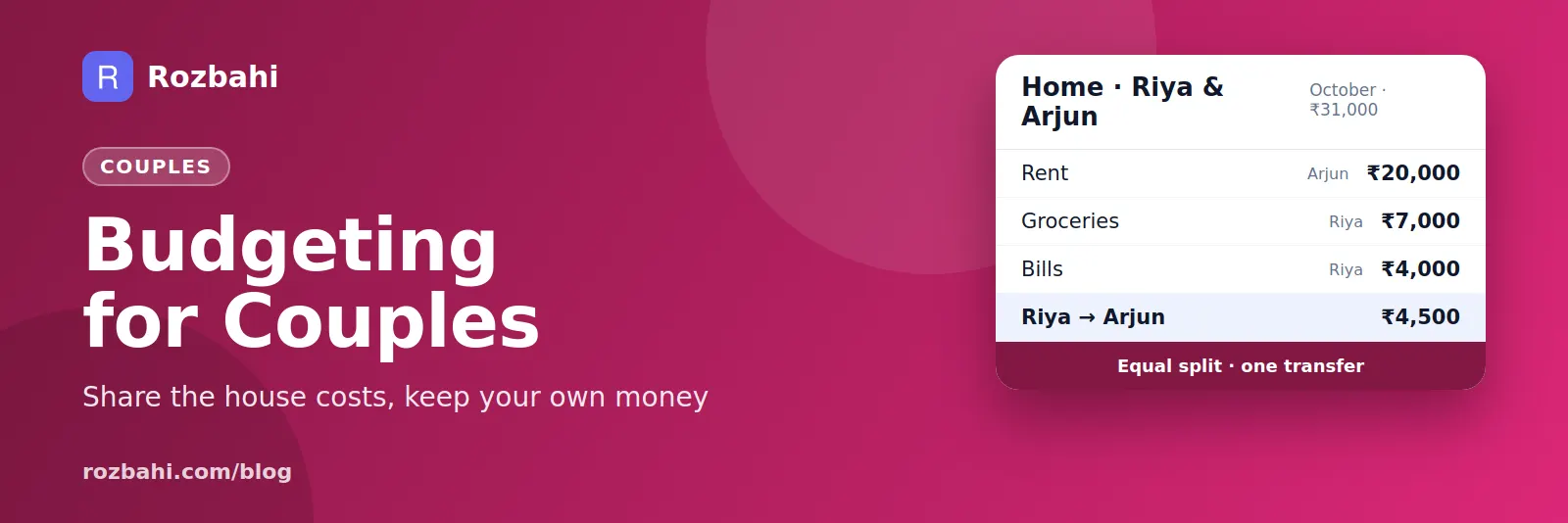
Riya and Arjun share rent, groceries and bills equally. In October, Arjun paid the rent (₹20,000), and Riya paid groceries (₹7,000) and bills (₹4,000). Shared costs total ₹31,000, so each person's share is ₹15,500. Arjun paid ₹4,500 more than his share, so Riya transfers ₹4,500 to Arjun. One transfer, and October is settled.
The monthly money talk
Once a month, 20 minutes, same day each month. A simple agenda keeps it calm:
- Look at the shared total and the top three categories.
- Settle up if you split costs.
- Check goals: how much went to joint savings?
- Plan next month: any big costs coming — a wedding, a trip, an annual bill?
- One change, agreed together.
Keep it about the household, not about blame. "Dining out was ₹6,000" is a fact to discuss; "you order too much" is an argument.
Personal money: the secret to fewer fights
Even fully joint couples benefit from a personal allowance for each partner — a fixed amount each month that can be spent on anything, with no questions asked. It removes the most common source of friction: feeling judged for small personal purchases. The amount matters less than the principle.
Saving together
- Emergency fund first: three to six months of essential costs. See how much emergency fund you need.
- Name your goals: a home, a car, a holiday. Named goals are easier to save for than "savings".
- Automate: move joint savings on salary day.
- Celebrate milestones together.
Common couple money mistakes
- Never talking about money until there is a problem.
- Hiding debts or purchases. Small secrets damage trust more than big numbers.
- Assuming the higher earner decides. Shared money means shared decisions.
- No personal space. Everyone needs some money that is just theirs.
Starting the first money conversation
If you have never talked about money in detail, start gently. Pick a calm moment, not right after a big purchase or an argument. Each of you shares three things: what you earn, what you owe, and one money goal you care about. Do not try to solve anything in the first talk. The aim is simply to put both pictures on the table without judgement.
In the second conversation, agree on the system — joint, separate or hybrid — and the list of shared costs. In the third, look at your first month of real numbers together.
When incomes are very different
When one partner earns much more, a strict 50/50 split of shared costs can leave the lower earner with little personal money, while the higher earner has plenty. That imbalance often creates quiet resentment on both sides. A proportional split solves it: both partners pay the same percentage of their income toward the household, and both keep the same percentage for themselves. Some couples go further and give both partners an equal personal allowance from the shared pool, whoever earns it.
Handling different spending styles
It is common for one partner to be a saver and the other a spender. Neither is wrong; both bring something useful — security and enjoyment. A few rules help:
- Agree a "check with each other" amount. Any single purchase above it, from shared money, is discussed first.
- Protect savings first so the saver feels secure.
- Protect personal money so the spender feels free.
- Look at the numbers, not the person. A shared tracker makes conversations about facts rather than impressions.
Money and life changes
A new job, moving in together, marriage, a baby, caring for parents — each one changes your budget. Revisit your system whenever life changes, not just when something goes wrong. What worked for two working professionals in a rented flat may not work for a family of three with one income.
Above all, keep talking. Couples who check in on money briefly and regularly rarely have the big money fights that couples who avoid the topic do.
How to do this in Rozbahi
- Create a two-person group in Rozbahi for your home and share the invite code with your partner.
- Add shared costs to the group; personal spending stays in each person's own account, private.
- See the month together: shared total and what each of you spent.
- Settle up: Rozbahi splits group costs equally and shows the transfer needed. If you split proportionally, use the group totals and settle the agreed amounts yourselves.
- Set budgets and savings goals for the household.
Frequently asked questions
Should married couples have a joint account?
Many do, but it is not required. A hybrid system — a joint account or group for shared costs plus personal money for each partner — works well for most couples.
How should couples split bills with different incomes?
A proportional split, where each pays the same percentage of income, is often seen as fairest. Equal splits are simpler. Agree together and write it down.
How often should couples talk about money?
A short monthly check-in prevents most conflicts, with a bigger review once or twice a year.
Share the household, keep your own: download Rozbahi.
Go deeper: Guide: how to make a monthly budget · Feature: budget planner · Guide: split expenses with flatmates · Feature: split expenses