Every household budget is made of two kinds of spending. Fixed expenses — rent, EMIs, insurance, internet — cost roughly the same every month. Variable expenses — groceries, fuel, eating out, shopping — change from month to month. Mixing them up is one of the most common reasons budgets fail. This guide explains the difference with examples, shows how to build a monthly fixed expenses list, and how to handle each type.
What are fixed expenses?
Fixed expenses are regular payments with the same (or nearly the same) amount, usually on the same date:
- Rent or home loan EMI
- Car, bike or personal loan EMIs
- Insurance premiums (monthly, or yearly divided by 12)
- Internet and broadband plans
- Mobile plans
- School or college fees (monthly share)
- Domestic help and drivers on a fixed salary
- Subscriptions — streaming, music, cloud storage, gym
- Society maintenance
They are predictable, which makes them easy to plan — and easy to forget, because they often leave your account automatically.
What are variable expenses?
Variable expenses change with your choices and circumstances:
- Groceries, milk, vegetables and fruit
- Electricity, water and gas (they recur, but the amount varies)
- Fuel and local transport
- Eating out and food delivery
- Shopping and personal care
- Entertainment and outings
- Medical costs and medicines
- Gifts, festivals and functions
This is where most of your monthly control lies, and where most overspending happens.
Semi-fixed expenses
Some expenses sit in between: they come every month, but the amount moves. Electricity is the classic example — higher in summer, lower in winter. Treat these as recurring bills with a variable amount: plan for them every month, but confirm the actual amount when the bill arrives.
Why the difference matters
- Fixed expenses set your baseline. Add them up and you know the minimum you need every month, before you spend anything else.
- Variable expenses are where savings come from. You cannot change rent this month, but you can change how often you order food.
- Different tools fit each. Fixed costs need a reliable list and reminders; variable costs need tracking and budgets.
- Fixed costs are worth reviewing once a year. A cheaper insurance plan or internet package saves money every month for a year.
How to make your monthly fixed expenses list
- Go through two or three months of bank, card and UPI statements.
- Write down every repeating payment: name, amount, due date, how it is paid.
- Add yearly and quarterly costs as a monthly share: a ₹18,000 yearly insurance premium is ₹1,500 a month.
- Add it all up. That is your fixed monthly baseline.
- Compare with your income. If fixed costs are more than about half of take-home pay, your budget will feel tight every month.
An example
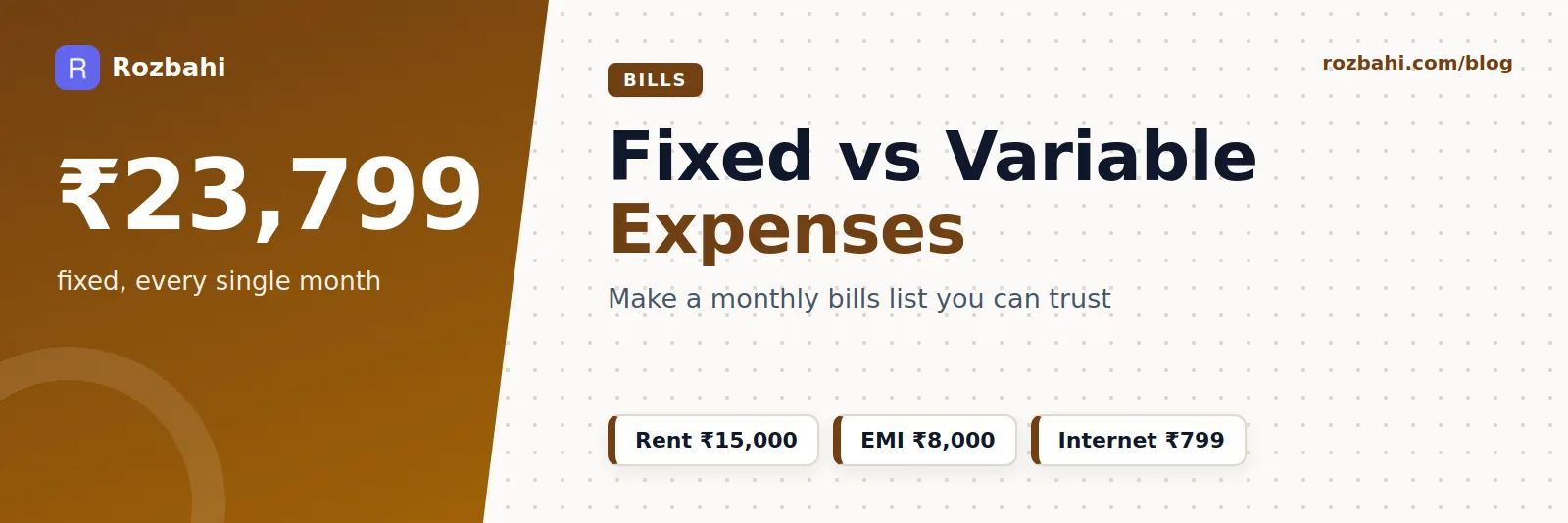
A household's fixed monthly expenses:
- Rent: ₹15,000
- Car loan EMI: ₹8,000
- Internet: ₹799
Fixed total: ₹23,799 every month. On top come variable costs — groceries around ₹9,000, electricity around ₹1,640, fuel, eating out and the rest. Knowing the ₹23,799 baseline tells the family exactly how much is left for everything else and for savings.
Managing fixed expenses
- Put them on a list with due dates so none are missed. See the bill reminder guide.
- Use autopay for amounts that never change, but keep recording them so your spending totals are complete.
- Review once a year: compare insurance, internet and mobile plans; cancel unused subscriptions — see how to track subscriptions.
- Negotiate or switch when a cheaper equivalent exists.
Managing variable expenses
- Track every expense in clear categories.
- Set monthly budgets for the biggest variable categories: groceries, dining out, fuel, shopping.
- Check weekly so you can adjust before the month is gone.
- Plan irregular costs like festivals with a small monthly set-aside.
Our monthly household budget guide puts both together step by step.
Common mistakes
- Forgetting yearly fixed costs, then calling the month they arrive a "bad month".
- Treating electricity as fixed and being surprised in summer.
- Ignoring small fixed costs like a ₹99 app subscription that renews for years.
- Trying to cut fixed costs every month instead of reviewing them properly once a year.
Fixed expenses as a share of income
A useful health check is how much of your take-home income goes on fixed costs. If fixed expenses take a modest share, you have room for variable spending and savings. If they take most of your income, every month feels tight, and even small surprises cause stress. In that case, the most powerful changes are fixed-cost changes: a cheaper home when the lease ends, prepaying an expensive loan, or dropping a costly plan. These take more effort, but they keep paying back every month.
Yearly and quarterly fixed costs
Not every fixed cost is monthly. Common yearly or quarterly ones include insurance premiums, vehicle insurance, school term fees, property tax, software and domain renewals, and memberships. Add each to your list with its real date and divide by 12 to get a monthly share. Set that share aside every month in a "planned extras" fund so the big bill never arrives as a shock.
Turn your list into a calendar
Sort your fixed expenses by due date. You will often find that most bills fall in the first ten days of the month. If your income arrives later, ask billers to move due dates closer to payday, or keep a one-month buffer in your account. A calendar view also helps you avoid weeks where several large bills land at once.
Review your list once a year
- Check each fixed cost: is it still needed?
- Compare prices for insurance, internet and mobile plans.
- Look for loans that could be prepaid or refinanced.
- Cancel unused subscriptions and memberships.
- Update your budget with the new fixed baseline.
The bottom line
Know your fixed baseline, put every fixed bill on a list with its date, review fixed costs once a year, and focus your monthly attention on variable spending. That simple split makes any budget easier to build and much easier to keep.
Spend twenty minutes this weekend writing your fixed list. It is the foundation of every budget that works.
How to do this in Rozbahi
- Add every fixed expense as a recurring bill in Rozbahi: name, amount, category, payment method, next due date and cycle — monthly, yearly, or every N days.
- Use auto mode for fixed amounts so they are recorded on the due date, and confirm mode for semi-fixed bills like electricity so you enter the real amount.
- See your bills list sorted by next due date.
- Track variable spending with quick add and templates, and set category budgets.
- Read the monthly report for totals by category and the change from last month — fixed and variable together.
Frequently asked questions
Is rent a fixed or variable expense?
Fixed. It is the same amount on the same date every month until the lease changes.
Are groceries fixed or variable?
Variable. They change with your choices, prices and how often you shop.
Are utility bills fixed or variable?
Usually semi-fixed: they recur every month, but the amount varies with usage.
How do I reduce fixed expenses?
Review them once a year: compare plans, cancel unused subscriptions, refinance or prepay loans where it makes sense, and renegotiate where possible.
Put every bill in one list: download Rozbahi.
Go deeper: Guide: how to make a monthly budget · Feature: budget planner