For many students, college is the first time they manage their own money. The pattern is familiar: the allowance or salary arrives, the first two weeks feel comfortable, and the last week is instant noodles and borrowed bus fare. Budgeting for students is not about being stingy. It is about making the money last the whole month, with room for the things that matter to you. This guide gives you a simple plan that works on any allowance.
Step 1: Know your monthly income
Add up the money you can count on each month:
- Allowance or pocket money from family
- Part-time job or freelance income
- Scholarship or stipend (monthly share)
If some income is irregular, budget only on what is certain. Extra money in a good month goes to savings or next month.
Step 2: List what you have to pay
Separate fixed costs from everyday spending:
- Fixed: hostel or PG rent (if you pay it), mess fees, phone and data plan, subscriptions you need for study, regular travel passes.
- Everyday: food outside the mess, snacks and coffee, local travel, books and printing, toiletries, outings with friends, shopping.
Step 3: Give every rupee a job
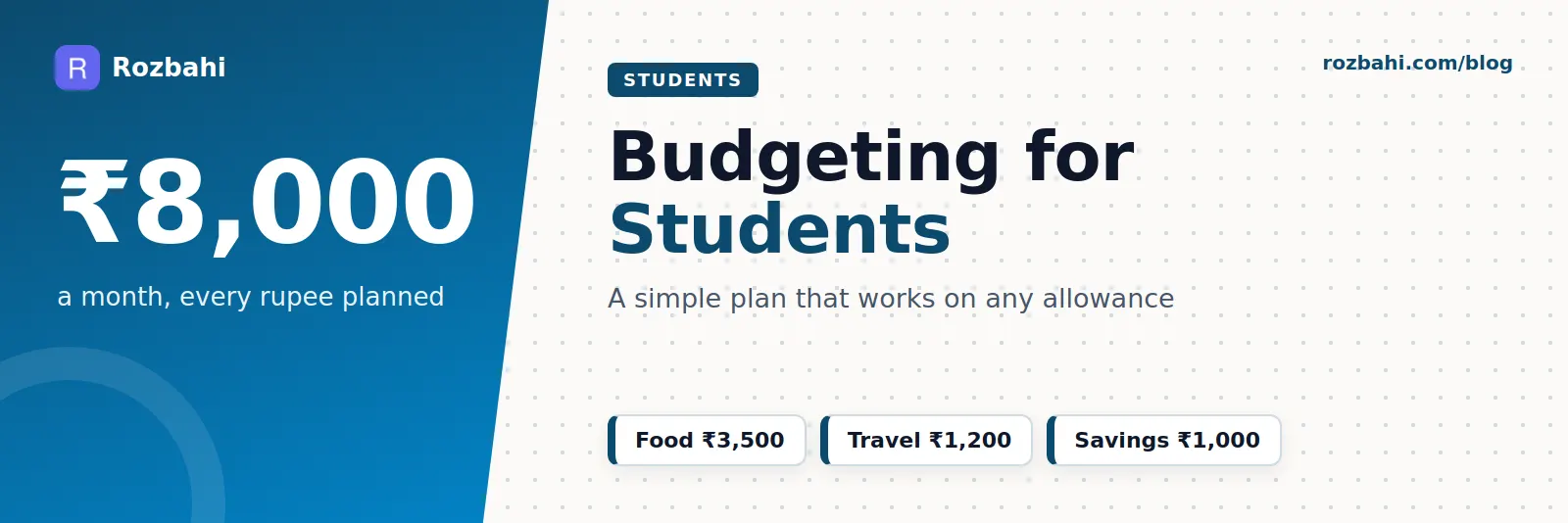
A sample student budget on ₹8,000 a month (rent and mess paid separately by family):
- Food and snacks: ₹3,500
- Local travel: ₹1,200
- Phone and data: ₹300
- Books, printing, stationery: ₹800
- Outings and fun: ₹1,200
- Savings: ₹1,000
Total: ₹8,000. Savings are on the list from day one — even ₹500 builds a habit and a small cushion.
Step 4: Split the month into weeks
Month-end shortfalls happen because the first two weeks spend too much. Divide your everyday spending by four or five and treat it as a weekly limit. In the example, food, travel and fun come to ₹5,900, so about ₹1,475 a week. If you are under on Sunday, carry it over; if over, cut back the next week.
Step 5: Track everything for a month
Students often underestimate small costs: chai, snacks, autos, printing, recharges, food delivery. Record every spend for one month — it takes seconds on your phone. Our guide on how to track daily expenses makes it a quick habit. After a month, you will know exactly where the money goes and can adjust your budget to reality.
Where student money usually leaks
- Food delivery and cafés: the biggest leak for most students.
- Small daily snacks and drinks.
- Short cab and auto rides that could be walked or shared.
- Subscriptions: streaming, music and apps, sometimes duplicated. See how to track subscriptions.
- Group outings where costs are not split fairly.
- Impulse online shopping during sales.
Smart money habits for students
- Use student discounts on travel, software, streaming and transport where available.
- Eat the mess food you have already paid for; outside food is the extra.
- Buy used books or use the library.
- Cook with friends if you have a kitchen; it is cheaper and more fun.
- Keep a small emergency fund — even ₹2,000 to ₹5,000 avoids borrowing for a surprise.
- Avoid credit you cannot repay. Buy-now-pay-later and credit cards are easy to start and hard to stop.
Sharing costs with flatmates and friends
Students often share rooms, groceries, Wi-Fi and trips. Unclear sharing is a common cause of money stress and friendship strain. Agree what is shared, record every shared cost in one place, and settle up on a fixed day each month. See how to split expenses with roommates and, for trips, how to split trip expenses.
Saving as a student
Saving on a small income is about habit, not amount. Set a small savings target — ₹500 or ₹1,000 a month — and move it on the day money arrives. Give it a goal: a laptop, a trip, a course. See how to set savings goals. A student who saves ₹1,000 a month for three years graduates with ₹36,000 and, more importantly, a habit that lasts.
When money runs out before month end
- Look at your tracker: which category went over?
- Cut back for the rest of the month: mess food, walking, free activities.
- Avoid borrowing if possible; if you must, borrow small and repay first thing next month.
- Next month, lower the limit in the category that went over, or increase your weekly checks.
Budgeting with a part-time job
If you earn from a part-time job, tutoring or freelance work, income may vary from month to month. Use your lowest normal month as the budget, and treat anything extra as a bonus for savings or a goal. Keep work income and family allowance in the same tracker so you see the full picture, and set aside money for any tax or fees that apply to your earnings.
Living in a hostel vs a shared flat
- Hostel or PG with mess: fewer bills, but outside food and snacks become the biggest variable cost. Track them closely.
- Shared flat: you also manage rent, groceries, Wi-Fi and electricity with flatmates. Agree what is shared and settle monthly.
- Living at home: fewer costs, which is a great time to build savings and an emergency fund.
Talking to family about money
If your family supports you, a short monthly update helps everyone. Show what you spent and where, especially on study costs. It builds trust, makes it easier to ask for help when a genuine extra cost comes up, and shows you can manage money — a skill that matters long after college.
A weekly 5-minute routine
- Check what you spent this week against your weekly limit.
- Look at the one category that went highest.
- Plan next week's bigger costs — a trip home, a project, an outing.
- Move anything left over to savings.
The bottom line
A student budget does not need to be complicated: know your income, plan food, travel and fun, set a weekly limit, save a little first and track every spend. Do that for one semester and money stress at month end becomes the exception, not the rule.
Start with your next allowance or pay day: write the plan, move your savings first, and track the first week.
How to do this in Rozbahi
- Sign up with your phone number in Rozbahi — no bank login needed.
- Record income when your allowance or salary arrives, and log every expense with quick add.
- Use templates for daily spends like chai, bus fare or lunch.
- Set monthly budgets for food, transport and fun, and watch the percentage used.
- Create a group with flatmates or for a trip, and settle up with the fewest payments.
- Check the monthly report for totals by category, your daily average and the change from last month.
Frequently asked questions
How much should a college student budget per month?
It depends on city, housing and whether rent and food are already paid. Track one month, then set limits based on your real spending and income.
What is the best way for students to save money?
Save a fixed amount on the day money arrives, cut food delivery and small daily spends, and use student discounts.
Should students use a budgeting app?
A simple, free app on your phone is often the easiest way to track small daily spending and stay within weekly limits.
Make your allowance last the month: download Rozbahi.
Go deeper: Guide: how to make a monthly budget · Feature: budget planner