A trip with friends is great until the last evening, when someone opens a notes app full of half-remembered amounts and asks, "so who owes whom?" Splitting trip expenses does not need to be awkward. With a few rules agreed before you leave and one place to log every payment, the final settle-up takes two minutes. This guide shows how.
Before the trip: agree the rules
Ten minutes in the group chat before you leave saves an argument later. Agree on:
- What is shared: usually stay, transport, fuel and tolls, shared meals, tickets and activities everyone joins.
- What is personal: souvenirs, personal shopping, solo activities, and often drinks.
- How to split: equally among everyone, unless you agree otherwise for specific costs.
- Where to log: one shared tracker, not five people's notes.
- When to settle: on the last day, or within a day of getting home.
Optional: a shared kitty
Some groups prefer a kitty: everyone puts in the same amount at the start, one person holds it and pays shared costs. It works well for small daily spends like snacks and tips. Still log what the kitty pays, so you can top it up or refund it fairly at the end.
During the trip: log every payment
- Whoever pays logs it, straight away, with a clear note: "Hotel 2 nights", "Fuel Panipat", "Dinner Mall Road".
- Log in the original amount paid, not each person's share; the app or the maths at the end works out shares.
- Keep personal spending out of the trip group.
- Check the log each evening — two minutes to catch anything missed while it is fresh.
Signal is often weak on the road, so an app that works offline and syncs later is a big help. See why in our offline expense tracker guide.
After the trip: settle in the fewest payments
Do not settle each expense separately. Net it out:
- Add up the total shared spending and divide by the number of people to get each person's share.
- For each person, subtract their share from what they paid. Positive means they are owed; negative means they owe.
- Match the biggest debtor with the biggest creditor, pay what is possible, and repeat.
A worked example
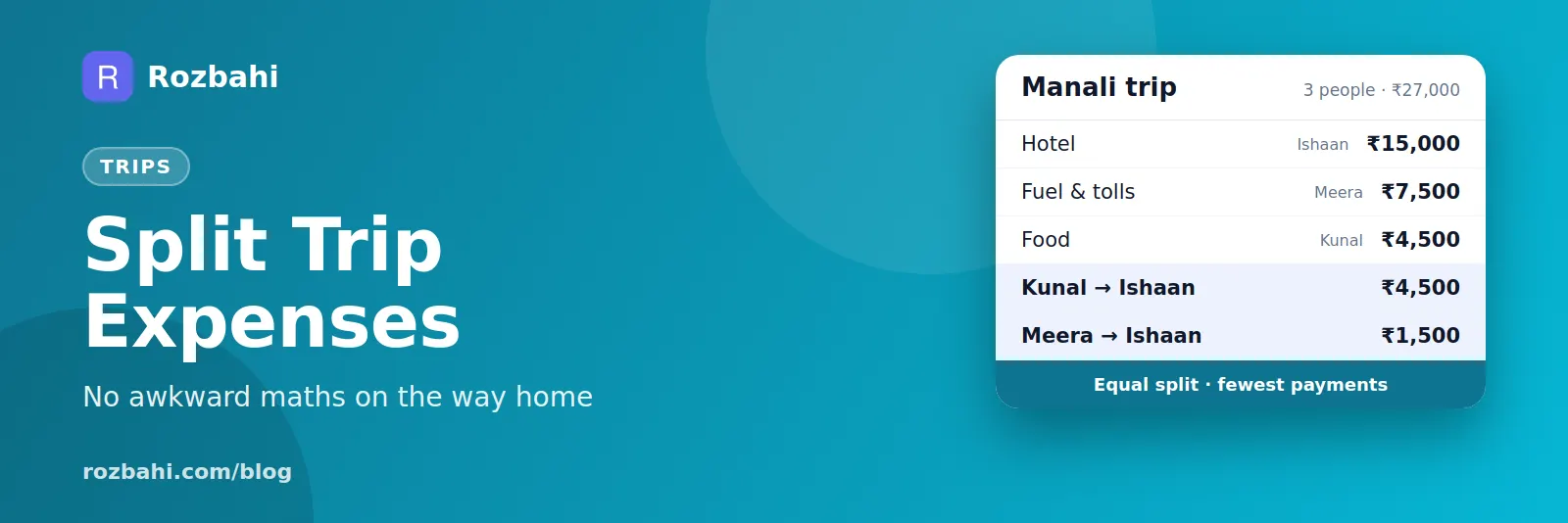
Ishaan, Meera and Kunal go to Manali. Ishaan pays the hotel (₹15,000), Meera pays fuel and tolls (₹7,500), Kunal pays for food (₹4,500).
- Total: ₹27,000. Each share: ₹9,000.
- Ishaan paid ₹15,000: he is owed ₹6,000.
- Meera paid ₹7,500: she owes ₹1,500.
- Kunal paid ₹4,500: he owes ₹4,500.
Settle-up: Kunal pays Ishaan ₹4,500, and Meera pays Ishaan ₹1,500. Two payments, done.
Handling the tricky cases
- Someone joins for only part of the trip: agree in advance which costs they share. Often the simplest way is to keep the days they missed outside their share — or run a separate group for those days.
- Someone does not drink or skips a meal: either keep drinks personal, or agree that the person who skips pays less for that meal and settle it separately.
- A room is shared unequally: if one person has a private room, agree a fixed extra amount for them before booking.
- Different currencies: convert every expense to one currency when you log it, using the rate you actually paid.
- Refunds and cancellations: log the refund as a reduction of the original shared cost, so shares stay correct.
Trip budgeting before you go
Splitting is easier when the group agrees a rough budget first: a per-person amount for stay, transport and food. It avoids the classic problem of one person booking an expensive hotel that others cannot afford. Share the plan in the group, and use the trip log to compare the plan with what you actually spent.
Etiquette that keeps friendships
- Settle quickly. Debts that linger turn into resentment.
- Round small amounts if everyone agrees — nobody needs to chase ₹7.
- Thank the planner — and do not expect them to also do all the maths.
- Be clear about exceptions before spending, not after.
A simple checklist for the trip organiser
- Create the shared trip group before anyone pays anything, including advance bookings.
- Share the agreed rules in the group chat: what is shared, how it is split, when you settle.
- Log advance bookings — tickets, hotel deposits — as soon as they are paid.
- On the trip, remind everyone each evening to add the day's payments.
- On the last day, open the settle-up and share the payments needed.
- Ask everyone to mark their payment as done so the trip is closed.
Why one shared log beats everyone's notes
When every person keeps their own notes, the same dinner gets recorded twice, a fuel stop is forgotten, and amounts are rounded differently. Totals never match, and the settle-up becomes a negotiation. One shared log, where each payment is recorded once by the person who paid, gives everyone the same numbers. The maths is then automatic, and nobody needs to trust anyone's memory.
Weekend trips vs long holidays
For a weekend trip, a single group and an equal split almost always work. For a week or more, a few extra rules help: settle halfway through so balances do not grow too large, agree a daily food budget, and decide early how to handle days when the group splits up. For a long trip, it can also be worth separating the big pre-booked costs (flights, hotels) from daily spending, so everyone can see both clearly.
After you get home
Settle within a day or two, while the trip is still fresh. Once the group is settled, look at your own share in your monthly spending: trips are often one of the biggest "wants" in a year, and knowing the real cost helps plan the next one.
A little structure before and during the trip means the only thing anyone remembers afterwards is the trip itself, not the maths.
Planning a trip soon? Set up the group tonight, before the first booking is paid.
How to do this in Rozbahi
- Create a trip group in Rozbahi and share the 6-letter invite code with your friends.
- Each person logs what they pay into the group, even with no signal; it syncs later.
- Open Settle up to see each person's balance and the fewest payments needed. Rozbahi splits group spending equally between members.
- Mark payments as done when they are made.
- Your own trip spending — souvenirs, personal shopping — stays in your personal account and still shows up in your monthly report.
Rozbahi works in Indian rupees and splits equally. For trips with unequal shares or several currencies, a dedicated splitter may suit better; see our Splitwise alternative comparison.
Frequently asked questions
What is the fairest way to split trip expenses?
Agree before the trip which costs are shared, split those equally, keep personal spending out, and settle the net balances at the end.
How do you settle a group trip with the fewest payments?
Work out each person's balance (paid minus share), then match those who owe with those who are owed, largest first. A group of three to five usually needs two to four payments.
Should drinks be split equally?
Only if everyone drinks similar amounts. Many groups keep drinks personal to avoid awkwardness.
Plan your next trip: download Rozbahi and create a trip group.
Go deeper: Guide: split expenses with flatmates · Feature: split expenses