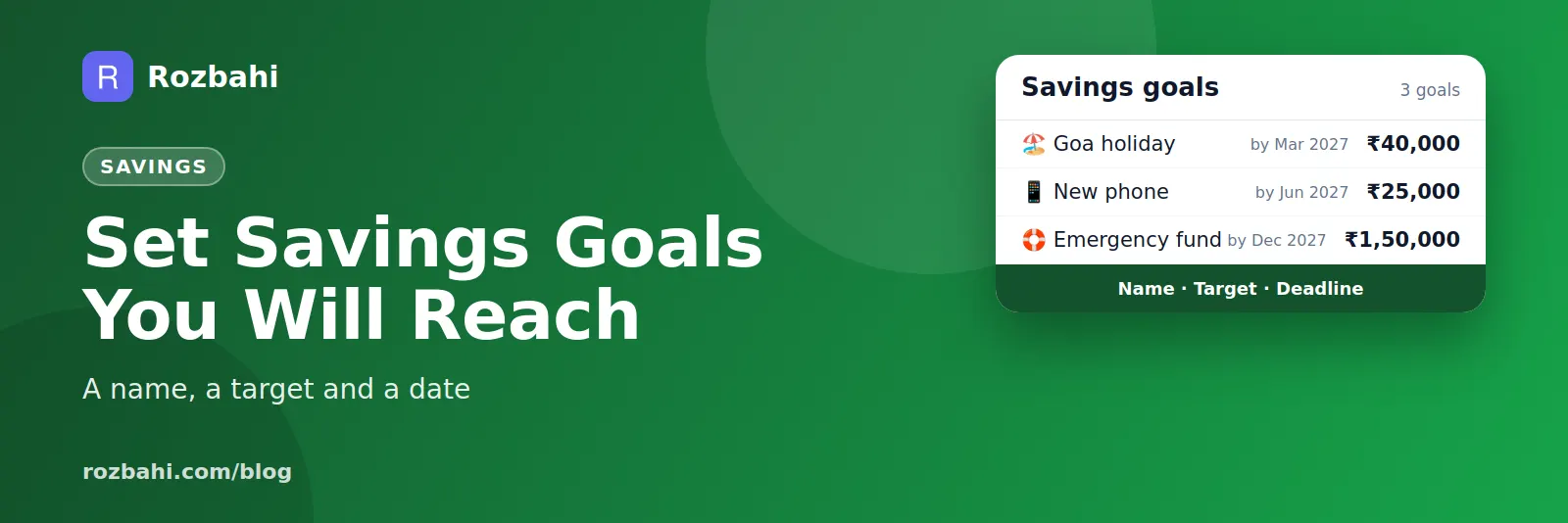
"I should save more" is a wish. "Save ₹40,000 for a Goa holiday by March" is a plan. The difference is not discipline — it is clarity. A savings goal with a name, a target amount and a deadline tells you exactly what to do each month, and makes it much easier to say no to spending that does not matter. This guide shows how to set savings goals you will actually reach, and how to keep them on track.
Why most savings goals fail
- Too vague: "save more" has no finish line.
- No deadline: without a date, next month always seems like a better time to start.
- Saving what is left: at the end of the month, there is rarely anything left.
- Too many goals at once: money spread thin means no goal moves.
- No tracking: without seeing progress, motivation fades.
Step 1: Name the goal
Give every goal a specific name: "Emergency fund", "New phone", "Goa holiday", "School fees for April", "House deposit". A name connects the money to something you care about, and that makes it harder to raid for something else.
Step 2: Set a target amount
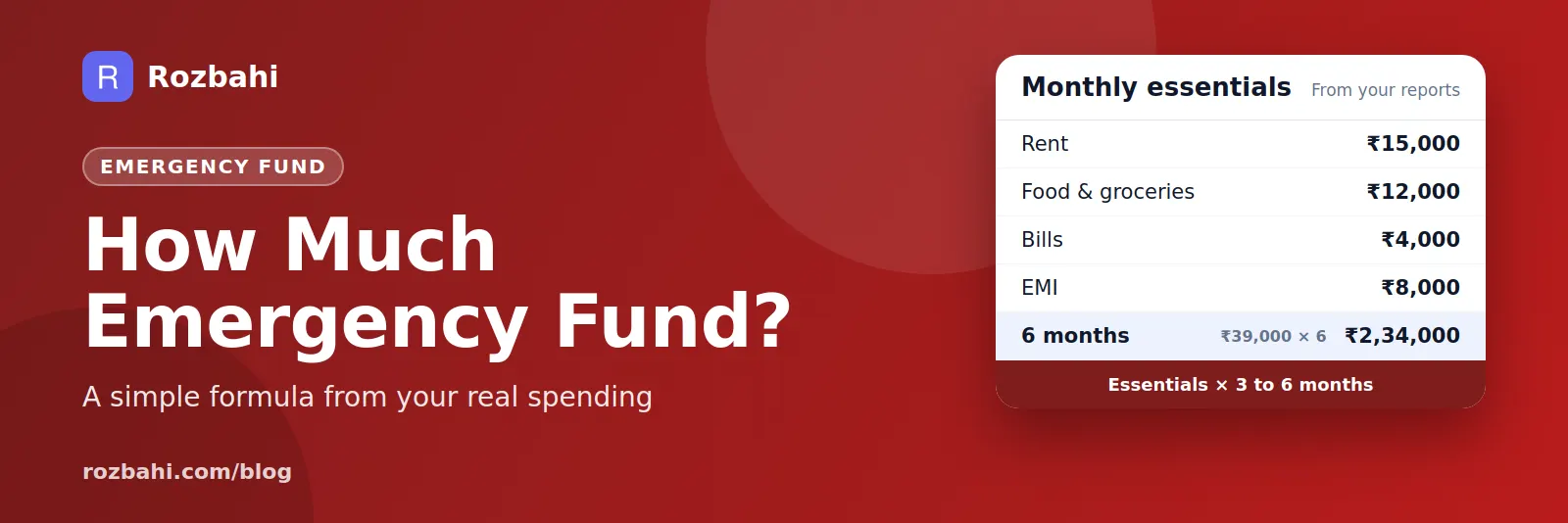
Research the real cost. For a holiday, add travel, stay, food and a buffer. For a phone, check the price of the model you actually want. For an emergency fund, use a few months of essential costs — see how much emergency fund you need. Round up slightly; finishing early feels better than falling short.
Step 3: Pick a realistic deadline
A deadline turns a target into a monthly number. Be realistic: a deadline that needs half your income will be abandoned in a month. Short-term goals (under a year) suit holidays and gadgets; medium-term goals (one to five years) suit vehicles, education and house deposits; long-term goals (five years or more) suit retirement and children's future.
Step 4: Work out the monthly amount
Monthly saving = (target − amount already saved) ÷ months until the deadline
Examples:
- Goa holiday: ₹40,000, starting from zero, in 5 months → ₹8,000 a month.
- New phone: ₹25,000, ₹5,000 already saved, in 8 months → ₹2,500 a month.
- Emergency fund: ₹1,50,000, ₹30,000 saved, in 24 months → ₹5,000 a month.
Add up all your goals' monthly amounts. If the total is more than you can save, move a deadline or lower a target — before you start, not after you have given up.
Step 5: Save first, automatically
The most reliable way to reach a goal is to move the monthly amount on salary day, before you spend anything. Many people keep a separate savings account, or a recurring deposit, for each big goal so the money is not mixed with daily spending.
Step 6: Prioritise
If you have several goals, a sensible order for most people is:
- A starter emergency fund — even one month of expenses.
- Paying off expensive debt, like credit card balances.
- The full emergency fund.
- Near-term goals with a fixed date, like school fees or a wedding.
- Wants like holidays and gadgets.
- Long-term investing, which ideally runs alongside everything else.
Find the money for your goals
If the monthly amount feels out of reach, look at your spending before giving up. One month of tracking usually shows two or three areas — food delivery, unused subscriptions, frequent small shopping — where a cut would fund a goal without hurting. Our guide on analysing your monthly spending walks through it.
Stay motivated
- Look at progress monthly, not daily.
- Celebrate milestones — a quarter, half, three quarters.
- Use windfalls: put part of any bonus or gift straight into a goal.
- Do not punish a missed month; adjust the plan and continue.
- Make it visible: a goal you see regularly is a goal you protect.
Savings goals as a couple or family
Shared goals — a home, a family holiday, children's education — work best when both partners agree the target, the deadline and who contributes what. Keep personal goals separate. Review shared goals together in your monthly money talk; see budgeting for couples.
Short, medium and long-term goals
Different goals need different approaches:
- Short-term (under a year): holidays, gadgets, festival spending, an insurance renewal. Keep the money safe and easy to reach, such as a savings account or a recurring deposit timed to the deadline.
- Medium-term (one to five years): a vehicle, a wedding, a house deposit, a course. Some people mix safe deposits with lower-risk investments, depending on how fixed the date is.
- Long-term (five years or more): retirement, children's higher education. Time allows for growth, so long-term investing is usually part of the plan. Consider advice from a qualified professional for these.
A worked plan for three goals
Neha takes home ₹70,000 a month and can save ₹15,500. She has three goals:
- Emergency fund: ₹1,50,000, ₹30,000 saved, 24 months → ₹5,000 a month
- Goa holiday: ₹40,000, 5 months → ₹8,000 a month
- New phone: ₹25,000, ₹5,000 saved, 8 months → ₹2,500 a month
Total: ₹15,500 — exactly what she can save. If something changes, such as a rent increase, she knows exactly which deadline to move instead of giving up on everything.
What to do when you fall behind
Missing a month is normal. Life happens. The important thing is to adjust rather than abandon:
- Recalculate the monthly amount with the new remaining balance and the same deadline.
- If that is too high, move the deadline a little later.
- If one goal keeps slipping, ask whether it still matters; it is fine to drop or shrink a goal.
- Protect the emergency fund first — it keeps a bad month from becoming debt.
Write your goals down today — a name, an amount and a date for each. That alone puts you ahead of most people, who never get past "I should save more".
Revisit your goals every few months and adjust them as life changes.
How to do this in Rozbahi
- Create a savings goal in Rozbahi with a name, a target amount and a deadline. Put your goals in the order that matters to you.
- Your goals sync across your devices, so they are there on a new phone too.
- Find the monthly amount with the formula above, and set aside that much on salary day.
- Free up money: use budgets and your monthly report to see where spending can be trimmed to fund the goal.
- Check monthly: your report shows total income, spending and the balance left — the money available for your goals.
Frequently asked questions
What is a good savings goal?
One that is specific, has a target amount and a deadline, and needs a monthly amount you can actually afford.
How many savings goals should I have?
Two or three active goals is usually manageable. More than that spreads money too thin.
Should I save or pay off debt first?
Build a small emergency fund first, then focus on expensive debt like credit cards, then the rest of your goals.
How much of my income should I save?
A common guide is at least 20% of take-home pay, as in the 50/30/20 rule. If that is not possible yet, start smaller and increase it with each pay rise.
Set your first goal today: download Rozbahi.
Go deeper: Feature: budget planner · Feature: expense reports