The 52-week money challenge is one of the most popular saving challenges in the world, because it starts small and builds a habit before you notice. In the classic version, you save a small amount in week one, double it in week two, triple it in week three, and so on. By week 52, you have a surprisingly large sum. This guide explains the challenge, gives you the numbers for different starting amounts, and shows how to keep going all year.
How the 52-week challenge works
Pick a base amount. Each week, save the base amount multiplied by the week number:
- Week 1: 1 × base
- Week 2: 2 × base
- Week 3: 3 × base
- …
- Week 52: 52 × base
The total after 52 weeks is the base amount × 1,378 (the sum of 1 to 52).
The savings chart: totals by base amount
- ₹10 base: week 1 ₹10, week 52 ₹520, total ₹13,780
- ₹20 base: week 1 ₹20, week 52 ₹1,040, total ₹27,560
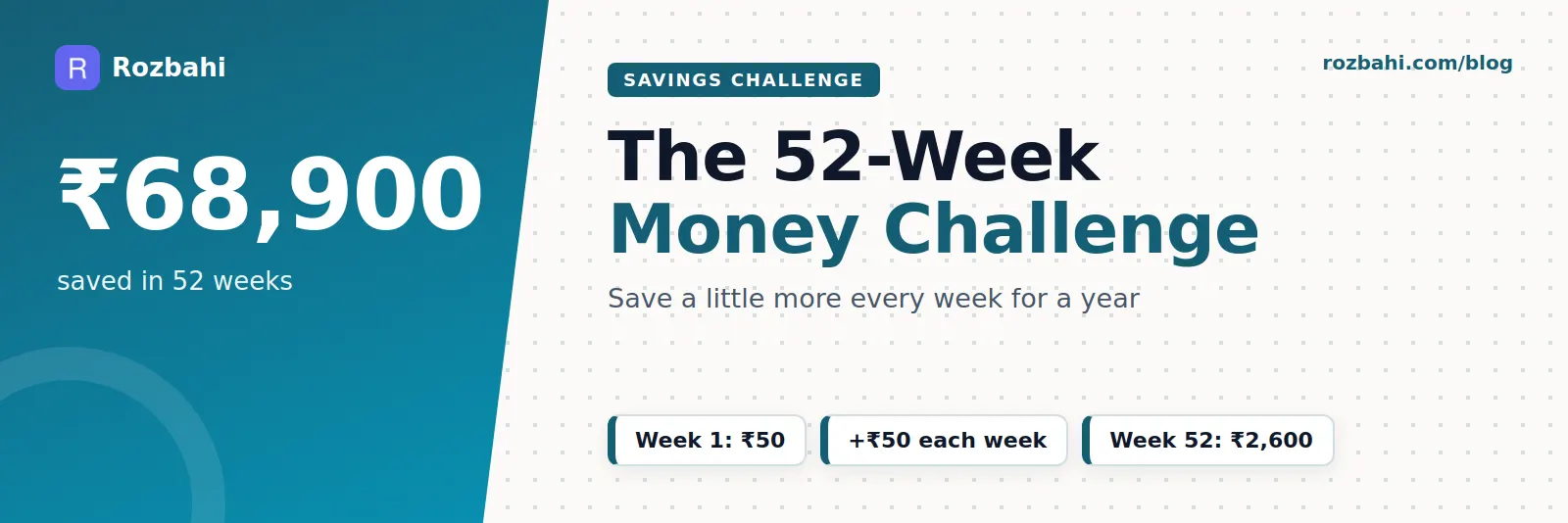
- ₹50 base: week 1 ₹50, week 52 ₹2,600, total ₹68,900
- ₹100 base: week 1 ₹100, week 52 ₹5,200, total ₹1,37,800
- $1 base: week 1 $1, week 52 $52, total $1,378
- $5 base: week 1 $5, week 52 $260, total $6,890
Choose a base you can sustain in the final weeks, not just the first ones. With a ₹50 base, December asks for over ₹2,400 a week.
Making a chart
A simple chart keeps you motivated. Write 52 rows: week number, amount to save, running total, and a tick box. With a ₹50 base, the first rows read: week 1 — ₹50 — ₹50; week 2 — ₹100 — ₹150; week 3 — ₹150 — ₹300; week 4 — ₹200 — ₹500. Tick each week as you save it. Print it and stick it on the fridge, or keep it as a note on your phone.
Variations that make it easier
Reverse challenge
Start with the biggest amount in week one and go down. Week 1 is 52 × base, week 52 is 1 × base. The total is the same, but the hard weeks come when motivation is highest — and the end of the year, with its festivals and holidays, is easy.
Flexible challenge
Keep the list of 52 amounts, but each week choose any amount you have not done yet. Tight week? Pick a small one. Bonus month? Tick off a big one. You still reach the same total.
Fixed weekly amount
Save the same amount every week — for example ₹1,325 a week with a ₹50 base gives about the same ₹68,900. Less exciting, but steady.
Monthly version
Prefer monthly saving? Add up the four or five weeks of each month and save that on payday.
Where to keep the money
- A separate savings account so it is not mixed with spending money.
- A recurring deposit if you choose the fixed-amount version.
- A cash box works for small bases, but bank savings are safer for larger totals.
Avoid keeping it in your daily account, where it tends to get spent.
Give the challenge a goal
A challenge with a purpose is easier to finish. Decide in week one what the money is for: an emergency fund, a holiday, a laptop, festival spending without stress. See how to set savings goals and how much emergency fund you need.
Find the money each week
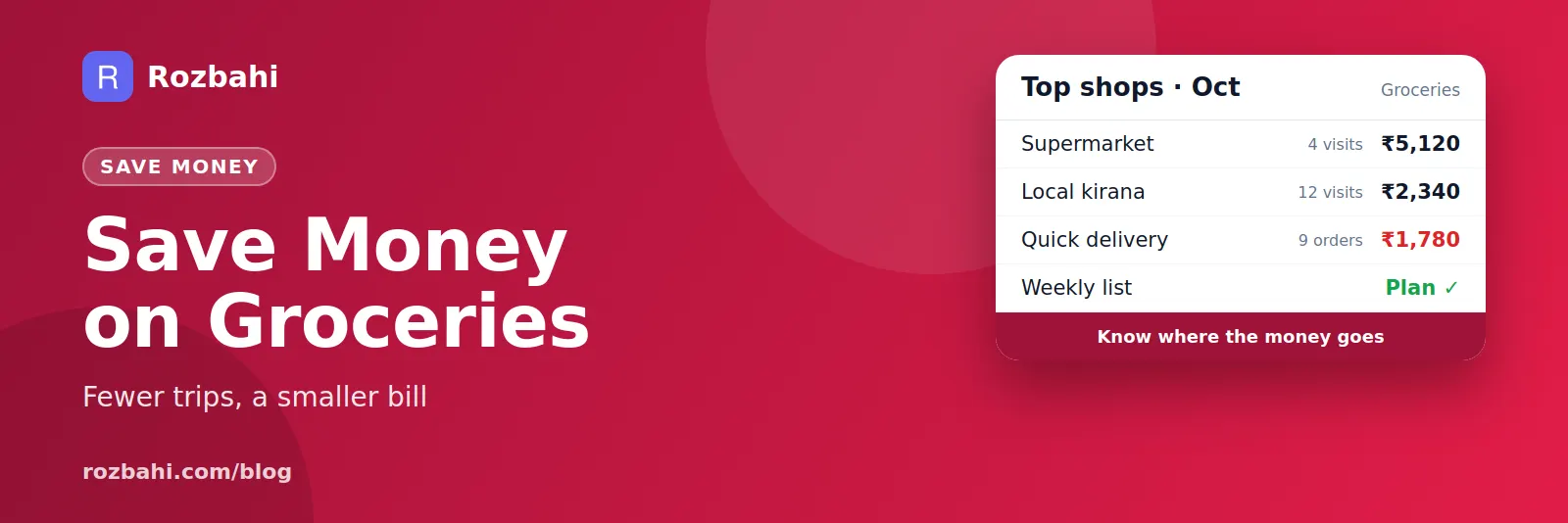
The early weeks are easy. The later weeks need real money, so plan where it comes from. Tracking your spending shows painless cuts: fewer delivery orders, an unused subscription, one less shopping trip. Our guide on analysing your monthly spending walks through it, and the no-spend challenge pairs well with the later weeks.
What to do if you miss a week
- Do not quit. Catch up over the next two or three weeks.
- Switch to the flexible version if the fixed order is too rigid.
- Lower the base if the later weeks are clearly too much; finishing a smaller challenge beats abandoning a bigger one.
Doing the challenge as a family or couple
The 52-week challenge works well as a shared project. Couples can each take alternate weeks, or both save the same base and double the total. Families can involve children with a small base — ₹5 or ₹10 — in their own chart, while the adults run a bigger one. Watching the totals grow together is motivating, and children learn how small, steady amounts add up.
Combine it with your budget
The challenge works best when it is part of your budget, not on top of it. Add a "52-week challenge" line to your monthly plan with the four or five weekly amounts for that month. As the weekly amount grows, look for the money in your variable spending: dining out, shopping, delivery. Our monthly household budget guide shows how to make room.
Plan for the expensive months
If you start in January with the classic version, the largest weekly amounts fall in November and December — often the most expensive months, with festivals and holidays. Look at your calendar before you start. If your big festival months are near the end, the reverse or flexible version may suit you better.
Celebrate the milestones
Mark the halfway point (week 26) and each quarter. With a ₹50 base, week 13 brings the total to ₹4,550, week 26 to ₹17,550, and week 39 to ₹39,000. Seeing the running total climb is one of the best reasons people finish.
The bottom line
Pick a base you can sustain, choose the classic, reverse or flexible version, keep the money in a separate account, give it a purpose and tick off every week. Fifty-two small steps add up to a total that most people are surprised to reach — and a saving habit that lasts long after the challenge ends.
Pick your base amount today and save your week one amount right now.
How to do this in Rozbahi
- Create a savings goal in Rozbahi — for example "52-week challenge", target ₹68,900, deadline 52 weeks from today.
- Keep the weekly chart on paper or in a note, and tick each week as you move the money into your savings account. Rozbahi stores the goal's name, target and deadline; your bank shows the saved balance.
- Find the money with budgets and your monthly report, which shows spending by category, your daily average and what is left after spending.
- Cut what you do not need using category budgets on dining out and shopping.
Frequently asked questions
How much do you save in the 52-week challenge?
Your base amount × 1,378. With ₹50 a week as the base, that is ₹68,900; with $1, it is $1,378.
Is the reverse 52-week challenge better?
For many people, yes: the biggest amounts come early when motivation is high, and the end of the year is easier.
Can I start the challenge in the middle of the year?
Yes. Start any week; the challenge is 52 weeks from your start date, not from January.
What if I cannot afford the last weeks?
Use the flexible or reverse version, or choose a smaller base. The habit matters more than the exact total.
Start your challenge this week: download Rozbahi and set your goal.
Go deeper: Feature: budget planner · Feature: expense reports