"Where does my money go?" is one of the most common money questions, and one of the easiest to answer. You do not need a financial adviser or a complicated spreadsheet. You need one month of recorded spending and a simple 15-minute review. This guide walks through exactly what to look at, in what order, and how to turn what you find into one change that makes a difference.
Before you start: one month of data
Analysis needs numbers. Record every expense for at least one full month — big and small, cash, UPI and card — in a fixed set of categories. If you have not started yet, read how to track daily expenses and come back after a month. Two or three months are even better, because they show trends.
The 15-minute monthly review
1. Total spending vs income (2 minutes)
Start with the big picture: how much came in, how much went out, and what is left. If spending is more than income, that is the first thing to fix. If there is a surplus, check it actually reached savings and was not spent in the following days.
2. Spending by category (4 minutes)
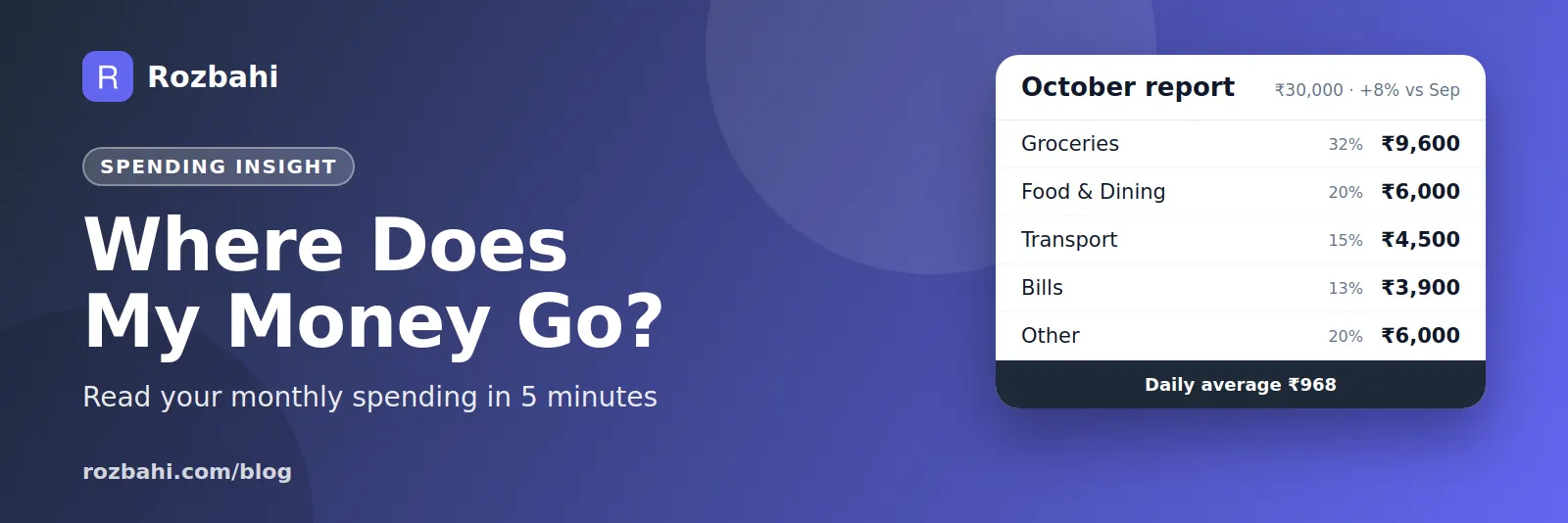
Sort your categories from largest to smallest and look at the percentage of total spending for each. In most households, three or four categories make up most of the spending. Those are where any change has the biggest effect. A typical breakdown might be groceries 32%, food and dining 20%, transport 15%, bills 13% and everything else 20%.
3. Change from last month (3 minutes)
Compare each category with the previous month. A category that jumped 30% deserves a question: was it a one-off (a festival, a repair) or a new habit (more delivery orders)? One-offs are fine if planned; habits are what to change.
4. Daily pattern and daily average (2 minutes)
Look at spending by day. Many people find their spending clusters on weekends, salary week, or the last days of the month. Your daily average — total spending divided by the days in the month — is a useful single number to watch. A month of ₹30,000 over 31 days is about ₹968 a day.
5. Top shops and merchants (2 minutes)
Which shops, apps or vendors appear most often, and which take the most money? A single delivery app or convenience store often turns out to be a top-three "shop" without you noticing.
6. Pick one change (2 minutes)
Do not try to fix everything. Choose one category and one specific action for next month: "Food delivery limit of ₹3,000", "One grocery trip a week", "Cancel the unused gym". One clear change beats five vague intentions.
Where money usually goes — and leaks
- Food delivery and eating out: often the fastest-growing category.
- Small daily spends: tea, snacks, short auto rides — individually tiny, collectively large.
- Subscriptions: forgotten plans that renew automatically. See how to track subscriptions.
- Grocery top-ups: frequent small trips and quick-delivery orders.
- Impulse shopping: online sales and "just browsing".
- Convenience costs: cabs instead of public transport, bottled water, ready meals.
Fixed, variable and occasional spending
When analysing, it helps to separate three types:
- Fixed: rent, EMIs, fees, insurance — hard to change in a month, worth reviewing once a year.
- Variable: groceries, dining, transport, shopping — where monthly changes happen.
- Occasional: festivals, repairs, travel — plan them with a monthly set-aside.
Focus your monthly review on variable spending; that is where one change pays off immediately.
A worked example
Ankit's October spending is ₹30,000, up 8% from September. Categories: groceries ₹9,600, food and dining ₹6,000, transport ₹4,500, bills ₹3,900, other ₹6,000. Food and dining jumped from ₹4,200 to ₹6,000 — 14 delivery orders instead of 8. His top shop is a delivery app. His one change for November: a ₹4,000 limit on food and dining, and cooking at home on weeknights. If it works, he saves ₹2,000 a month, ₹24,000 a year.
From analysis to a budget
After two or three monthly reviews, you have everything needed for a realistic budget: real category totals, known patterns and a sense of what you can change. Turn the categories into limits slightly below your real spending, and pay savings first. Our monthly household budget guide shows how.
Make it a monthly habit
Put the review in your calendar for the first weekend of each month. Do it with your partner or family if you share costs. Keep a note of the one change you chose, and check at the next review whether it worked. Over a year, twelve small changes add up to a very different financial picture.
Questions to ask during your review
- Which category grew the most, and why?
- Which spending did I enjoy and value? Which did I barely notice?
- Was there anything I bought that I would not buy again?
- Did I stay within the limits I set last month?
- What is one thing coming up next month that I should plan for?
The second question matters more than it seems. The goal is not to spend less on everything, but to spend more on what you value and less on what you do not.
Reviewing as a household
If you share costs with a partner or family, review household spending together. Look at the shared total and categories, not at who spent what. Agree one change together, and check it next month. Shared reviews turn money from a source of tension into a shared plan.
When the numbers surprise you
Almost everyone finds a surprise in their first review — usually a category much bigger than expected. That is not a failure; it is the point. Do not try to fix it all at once. Set a limit a little below this month's figure, choose one practical change, and see what happens. Most people bring a surprising category down by a quarter within two or three months, simply because they can now see it.
Fifteen minutes a month is all it takes.
Start this weekend.
How to do this in Rozbahi
- Record every expense in Rozbahi with quick add, templates and recurring bills, including income entries.
- Open the monthly report: total expense, total income and the balance; spending by category with percentages; spending by day; your top shops; your daily average; and the change from last month.
- Set a budget for the category you want to change and watch the percentage used during the month.
- Use Trends for advanced reports across months (part of Plus, or unlocked by inviting a friend).
- Export to PDF or Excel if you want to analyse further in a spreadsheet.
Frequently asked questions
How do I figure out where my money is going?
Record every expense for a month in fixed categories, then review totals, categories, change from last month, daily pattern and top shops.
How often should I review my spending?
A quick weekly check and a 15-minute monthly review work well for most people.
What is a good daily spending average?
There is no universal number. Use your own daily average as a baseline and watch whether it rises or falls month to month.
Find out where your money goes: download Rozbahi and review your first month.
Go deeper: Guide: how to track daily expenses · Feature: daily expense tracker