A monthly household budget is simply a plan: before the month starts, you decide how much each part of home life is allowed to cost. Done well, it is not about cutting everything. It is about choosing where money goes instead of finding out at the end of the month. This step-by-step method works for a single person, a couple or a joint family.
Step 1: Know your monthly income
Write down the money that reliably arrives each month after tax: salaries, regular freelance income, rent received, pension. If income varies, use your lowest normal month, not your best one. Extra money in a good month goes to savings.
Step 2: List your fixed bills
Fixed bills are roughly the same every month and hard to change quickly:
- Rent or home loan EMI
- Electricity, water, gas, internet, mobile
- School or college fees, insurance premiums
- Subscriptions you actually use
- Domestic help, if any
Add them up. This is the part of the month that is already spoken for. Tracking them as recurring bills means you never forget one; see our bill reminder guide.
Step 3: Find out what you really spend on everything else
This is the step most people skip, and it is why their budgets fail. Guessing "groceries are about ₹5,000" is not enough. Track every expense for at least one month; our guide on how to track daily expenses makes it a two-minute daily habit. At the end of the month you will have real numbers for groceries, milk, vegetables, transport, dining out and shopping.
Step 4: Set a limit for each category
Start from what you actually spent and adjust:
- Essentials (groceries, milk, vegetables, transport): set the limit close to your real spending, maybe 5–10% lower.
- Flexible spending (dining out, shopping, entertainment): this is where cuts are easiest. Pick a number you can live with.
- Irregular costs (festivals, birthdays, repairs, annual fees): divide the yearly amount by 12 and set it aside every month.
Step 5: Pay savings first
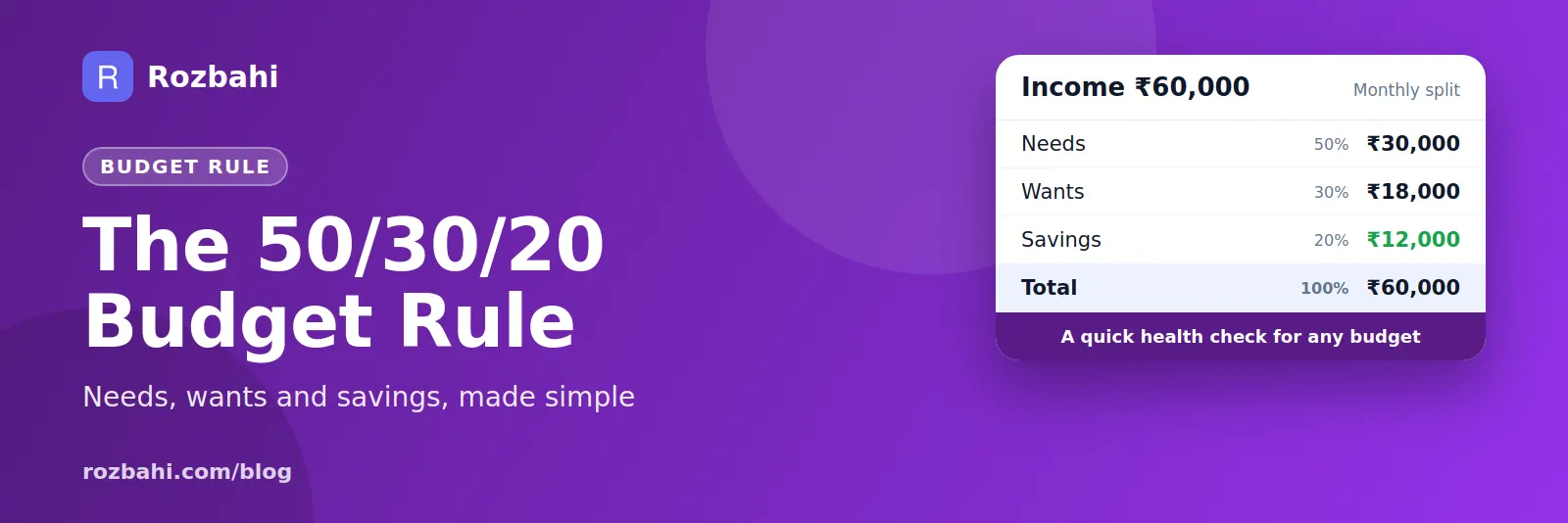
Decide on a savings amount and treat it like a bill that is paid on salary day. Even 10% of income is a strong start. Many people use the 50/30/20 idea as a rough guide: about half for needs, up to 30% for wants and at least 20% for savings, adjusted to local costs.
Step 6: Check weekly and adjust monthly
A budget is not a one-time document. Once a week, look at how much of each limit is used. If groceries are at 80% by the 20th, you know to slow down. At the end of the month, move limits up or down based on what happened.
A worked example
A family of four with a take-home income of ₹80,000:
- Savings first: ₹12,000
- Fixed bills: rent ₹18,000, utilities and internet ₹4,500, school fees ₹6,000, insurance ₹2,500 — total ₹31,000
- Essentials: groceries ₹9,000, milk ₹2,000, vegetables and fruit ₹3,500, transport and fuel ₹4,500 — total ₹19,000
- Flexible: dining out ₹3,000, shopping ₹4,000, entertainment ₹2,000 — total ₹9,000
- Irregular fund: ₹4,000 for festivals, repairs and gifts
- Buffer: ₹5,000 left for surprises
Total planned: ₹80,000. Every rupee has a job, including the buffer.
Common mistakes
- Budgeting from memory instead of real spending.
- Forgetting irregular costs, then calling the month a failure when Diwali or a car repair arrives.
- Too many categories. Ten to fifteen is enough.
- Never reviewing. A budget you do not check is a wish.
Budgeting methods: which one suits your home?
There is no single right way to budget. Four common methods, and who they suit:
- Category limits (the method in this guide): a monthly cap per category. Best for most households because it matches how families think: groceries, bills, school.
- 50/30/20: split take-home income into needs, wants and savings. Good as a quick health check, less precise for daily decisions.
- Envelope budgeting: a fixed amount of money per category, physical or digital; when the envelope is empty, spending stops. Strong discipline, good for people who overspend on one or two categories.
- Zero-based budgeting: every rupee of income is given a job before the month starts. Thorough, but needs more time each month.
Most families do well with category limits plus a savings amount paid first. You can add stricter methods to a problem category later.
Budgeting with irregular income
Freelancers, business owners, commission earners and farmers do not get the same amount every month. A budget still works with three adjustments:
- Find your baseline. Look at the last 12 months and take your lowest normal month as the budget income.
- Build a buffer account. In good months, put the extra into a separate account until it covers one to three months of expenses.
- Pay yourself a salary. Each month, move a fixed amount from the buffer to your spending account, as if you had a salary.
Plan for the months that are different
Every year has expensive months: festivals, weddings, school admissions, annual insurance, holidays. Write them down in January with a rough amount. Divide the yearly total by 12, and set that much aside every month in a "planned extras" category. When Diwali or the school admission arrives, the money is already there and the month does not break your budget.
Budgeting for a family vs for one
Single people can budget alone and adjust quickly. Families need agreement: who pays which bills, which categories are shared, and who checks the numbers. A short monthly family review, and a shared tracker where every household expense counts, keeps everyone on the same page. Our family expense tracker guide covers how to set this up.
Signs your budget is working
- You finish most months with money left in the buffer.
- Savings go out on salary day without a second thought.
- Festival and annual costs no longer feel like emergencies.
- Family money conversations are shorter and calmer.
If none of these are true yet, give it three months. Most budgets need two or three rounds of adjustment before the limits match real life.
Start simple: one month of honest tracking, a handful of category limits and savings paid first. That alone puts most households ahead of where they were.
How to do this in Rozbahi
- Track for a month with quick add and templates in Rozbahi.
- Put fixed bills on repeat with recurring rules (monthly, yearly or a custom cycle).
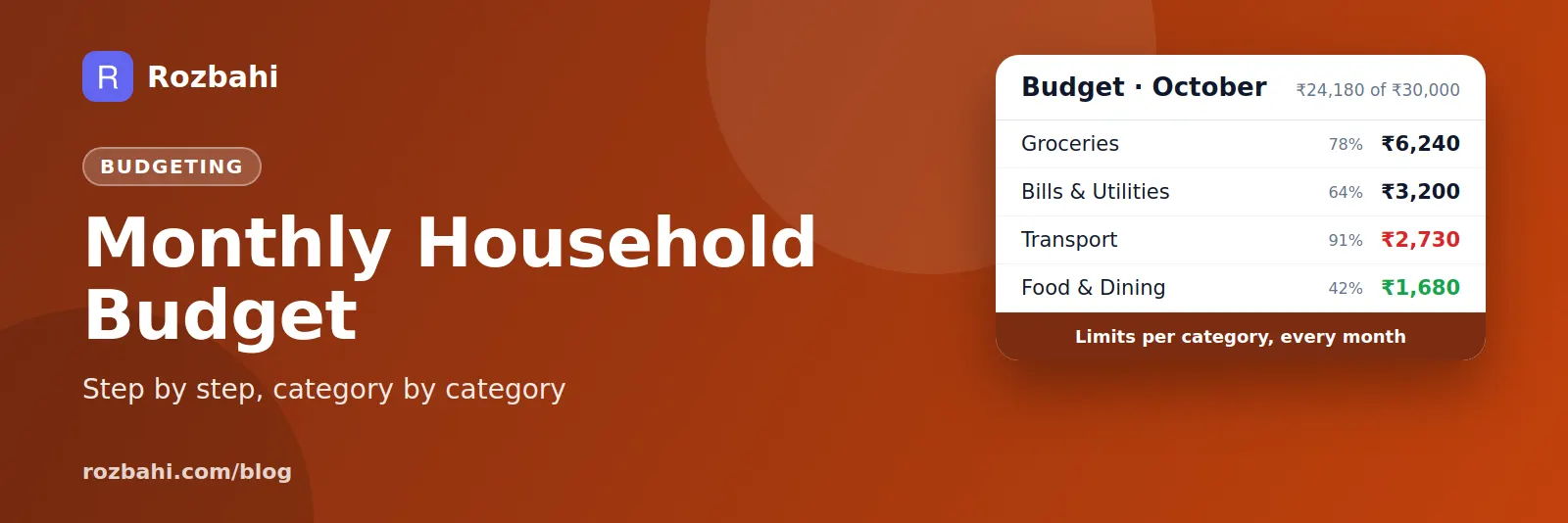
- Set a monthly limit per category on the Budget screen. Rozbahi shows what you have spent, the percentage used, and your total budget against total spending for the month.
- Check the monthly report for category totals, your daily average and the change from last month.
- Budget as a family: share household spending in a family group so everyone's entries count.
Frequently asked questions
How much should a family spend on groceries per month?
It depends on city, family size and diet. Use your own last one to three months of tracked spending as the starting point, then aim to trim 5–10% through planning and fewer top-up trips.
What if my income changes every month?
Budget on your lowest normal month. In better months, send the extra straight to savings or the irregular-costs fund.
How often should I change my budget?
Review weekly, change limits monthly. Big life changes, like a new job, a move or a new baby, deserve a fresh budget.
Build yours: download Rozbahi and set your first category budget today.
Go deeper: Guide: how to make a monthly budget · Feature: budget planner