A flat, a trip or a family group shares costs for a month. Asha paid for groceries, Ben paid the Wi-Fi, Chetan paid a dinner, and Divya paid nothing yet. Now everyone wants to settle. If each person pays back each other person for each expense, you end up with a tangle of small transfers. There is a better way: work out each person's overall balance, then clear the whole group in the fewest possible payments. This guide explains how settling group expenses works, step by step.
Why settling every expense separately is a mess
In a group of four, there are six possible pairs of people. If everyone settles every pair, you can need up to six payments — more if you settle each expense individually. With five people there are ten pairs, with six people fifteen. Each transfer is one more chance for mistakes and one more "did you pay me back?" message. Netting balances first cuts this down to at most one payment fewer than the number of people, and often less.
Step 1: Add up the shared total and each share
Add every shared expense for the period. If the group splits equally, divide by the number of people to get each person's fair share.
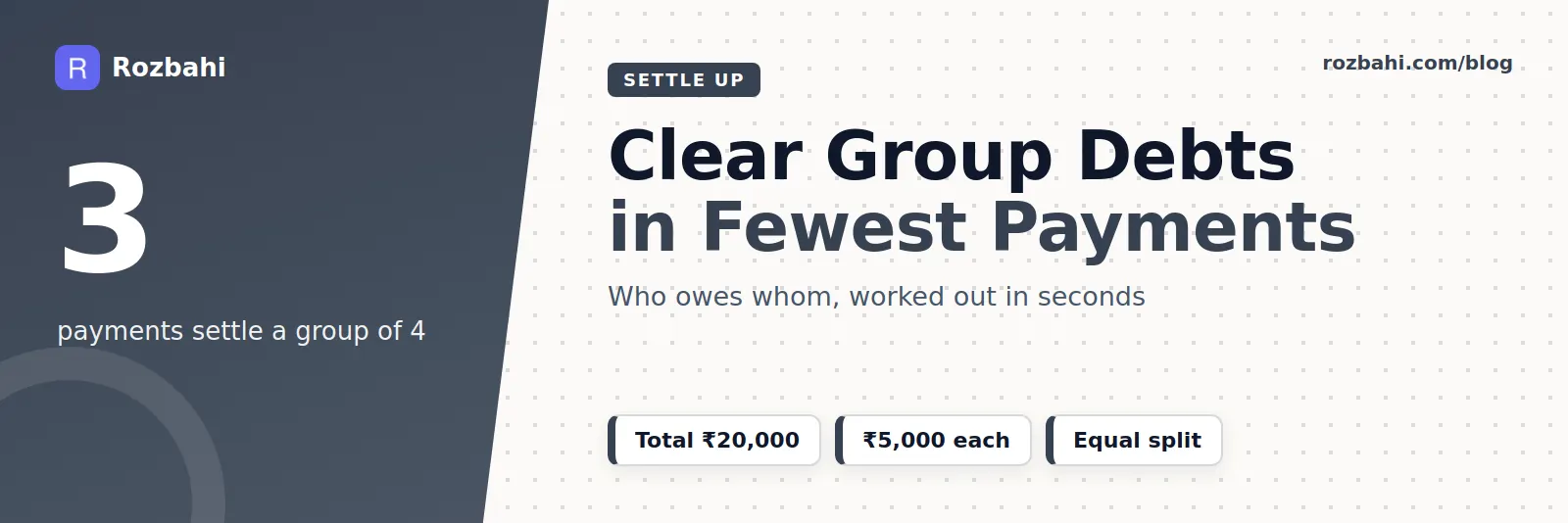
Example: Asha paid ₹12,000, Ben ₹6,000, Chetan ₹2,000, Divya ₹0. Total ₹20,000; four people; each share ₹5,000.
Step 2: Work out each person's balance
Balance = what they paid − their share
- Asha: ₹12,000 − ₹5,000 = +₹7,000 (is owed)
- Ben: ₹6,000 − ₹5,000 = +₹1,000 (is owed)
- Chetan: ₹2,000 − ₹5,000 = −₹3,000 (owes)
- Divya: ₹0 − ₹5,000 = −₹5,000 (owes)
Balances always add up to zero: +7,000 + 1,000 − 3,000 − 5,000 = 0. If yours do not, an expense was entered wrongly.
Step 3: Match who owes with who is owed
Sort the people who owe (most first) and the people who are owed (most first). Then repeat:
- Take the biggest debtor and the biggest creditor.
- The debtor pays the smaller of the two amounts.
- Reduce both balances; remove anyone who reaches zero.
In the example:
- Divya (−₹5,000) pays Asha (+₹7,000) ₹5,000. Divya is settled; Asha is now owed ₹2,000.
- Chetan (−₹3,000) pays Asha (+₹2,000) ₹2,000. Asha is settled; Chetan still owes ₹1,000.
- Chetan (−₹1,000) pays Ben (+₹1,000) ₹1,000. Everyone is settled.
Three payments clear the whole group. Settling every pair separately could have needed up to six.
Why this is fair
Debt simplification does not change what anyone pays in total. Divya still pays exactly her ₹5,000 share; Asha still gets back exactly the ₹7,000 she paid beyond her share. It only changes who pays whom, so money moves in fewer steps. Some people are surprised to pay someone they did not directly share an expense with; that is normal and still correct.
Equal vs unequal splits
The method works for any split. The only difference is step 1: with an unequal split, each person's share is their agreed portion instead of total ÷ people. For example, if one person has the bigger room and pays 40% of shared costs, their share is 40% of the total. Steps 2 and 3 stay the same.
Settling on a schedule
- Flats and households: settle monthly, on a fixed date such as the 1st.
- Trips: settle on the last day, or within a day of returning.
- Long-running groups: settle at least monthly; balances that grow for months are harder to clear and cause friction.
Common settling mistakes
- Personal costs in the shared pot. A personal purchase recorded as shared throws off every balance.
- Double entries. The same bill logged by two people. Rule: whoever paid, logs it.
- Forgetting to record the settlement. If a payment is not marked, the same debt appears again next time.
- Rounding differently. Agree to round to the nearest rupee, or ten, before settling.
- Leaving people out. Someone who joined halfway may need a separate calculation for the period they were there.
Settling with people who are not in the app
Sometimes one member of a group does not use the same tracker. You can still settle fairly: one person records the expenses that member paid on their behalf, with a clear note, and shares the settle-up result. It is not as smooth as everyone logging their own payments, but the maths stays the same.
Where this is useful
- Flatmates sharing rent, bills and groceries — see splitting with roommates.
- Trips with friends — see splitting trip expenses.
- Families sharing a household or a parent's costs — see the family expense tracker guide.
- Couples sharing a home — see budgeting for couples.
A bigger example: six flatmates
Six flatmates share ₹36,000 of costs in a month, so each share is ₹6,000. Their balances are +₹9,000, +₹3,000, +₹1,000, −₹2,000, −₹5,000 and −₹6,000. Settling every pair could take up to fifteen transfers. With the matching method:
- The −₹6,000 person pays the +₹9,000 person ₹6,000 (who is now owed ₹3,000).
- The −₹5,000 person pays the +₹9,000 person ₹3,000 and the +₹3,000 person ₹2,000.
- The −₹2,000 person pays the +₹3,000 person ₹1,000 and the +₹1,000 person ₹1,000.
Five payments instead of up to fifteen, and every balance is zero.
Keeping a clean record
A good settle-up starts with good records. Each shared expense should have the amount, who paid, the date and a short note. When everyone records their own payments as they happen, the end-of-month calculation is quick and nobody disputes the numbers.
The bottom line
Add up the shared total, work out each person’s share and balance, then let the biggest debtor pay the biggest creditor until everyone is at zero. It is fair, it is quick, and it turns a tangle of small transfers into a handful of clear payments that close the month for good.
Pick a settle-up date for your group today, and stick to it every month.
How to do this in Rozbahi
- Create a group in Rozbahi and share the 6-letter invite code.
- Each member records shared costs they paid into the group.
- Open Settle up for the month: Rozbahi works out each member's balance with an equal split and lists the fewest payments, using the same "biggest debtor pays biggest creditor" method shown above.
- Confirm each payment once it is made. Only payments that match the calculated settle-up can be confirmed, so nobody can record a made-up amount, and confirming twice does not double count.
- Settle every month — Rozbahi calculates settle-up month by month.
Rozbahi splits group spending equally between members. For unequal shares, use the method in this guide with your agreed percentages.
Frequently asked questions
What is debt simplification?
Working out each person's net balance across all shared expenses, then settling with the fewest payments instead of paying back each expense separately.
How many payments does a group need to settle?
At most one fewer than the number of people with a non-zero balance. A group of four usually needs two or three.
Is it fair if I pay someone I did not share an expense with?
Yes. You still pay exactly your share in total; only the route changes.
How often should a group settle up?
Monthly for households and flats; at the end for trips.
Settle your next group the easy way: download Rozbahi.
Go deeper: Guide: split expenses with flatmates · Feature: split expenses