Envelope budgeting is one of the oldest money systems there is. On payday, you divide cash into envelopes — one for groceries, one for transport, one for eating out — and spend each category only from its envelope. When an envelope is empty, spending in that category stops until next month. It is simple, visual and surprisingly effective. The catch: almost nobody pays only in cash anymore. This guide explains how the envelope budgeting method works, and how to run it digitally when most of your spending is UPI and card.
How the cash envelope system works
- Choose your envelope categories. Usually the variable ones where overspending happens: groceries, dining out, transport, shopping, entertainment.
- Decide each envelope's amount for the month, based on real past spending.
- Fill the envelopes on payday — physically with cash, in the original version.
- Spend only from the right envelope. Groceries come from the grocery envelope, nowhere else.
- When an envelope is empty, stop — or move money from another envelope on purpose, never by accident.
- At month end, leftover money goes to savings or next month's envelope.
Fixed bills like rent, EMIs and utilities usually stay out of envelopes; they are paid directly from the bank account.
Why envelopes work so well
- Hard limits. An empty envelope is impossible to ignore.
- Constant feedback. You can see how much is left at any moment.
- Trade-offs become real. "If I eat out tonight, the shopping envelope pays for it" is a clearer choice than a vague bank balance.
- Overspending is contained. A bad month in one category does not quietly spread to the whole budget.
The problem with cash envelopes today
Physical envelopes struggle in a world of UPI, cards and online orders. Carrying cash for every category is impractical, many shops prefer digital payment, and online purchases cannot be paid from a paper envelope. That does not make the method obsolete. It just means the envelopes need to be digital.
Digital envelopes: the same idea, without cash
A digital envelope is simply a category with a monthly limit, where you can see "spent" and "left" at a glance. You pay however you like — UPI, card or cash — and record each expense in its category. The tracker does the subtraction. The rules stay the same:
- Every category has a limit set at the start of the month.
- Every expense is recorded in its category, as it happens.
- When a category reaches its limit, stop or consciously move money from another category.
- Leftover money is saved, not silently spent.
Choosing your envelopes
Start with five to eight envelopes for variable spending. A household example:
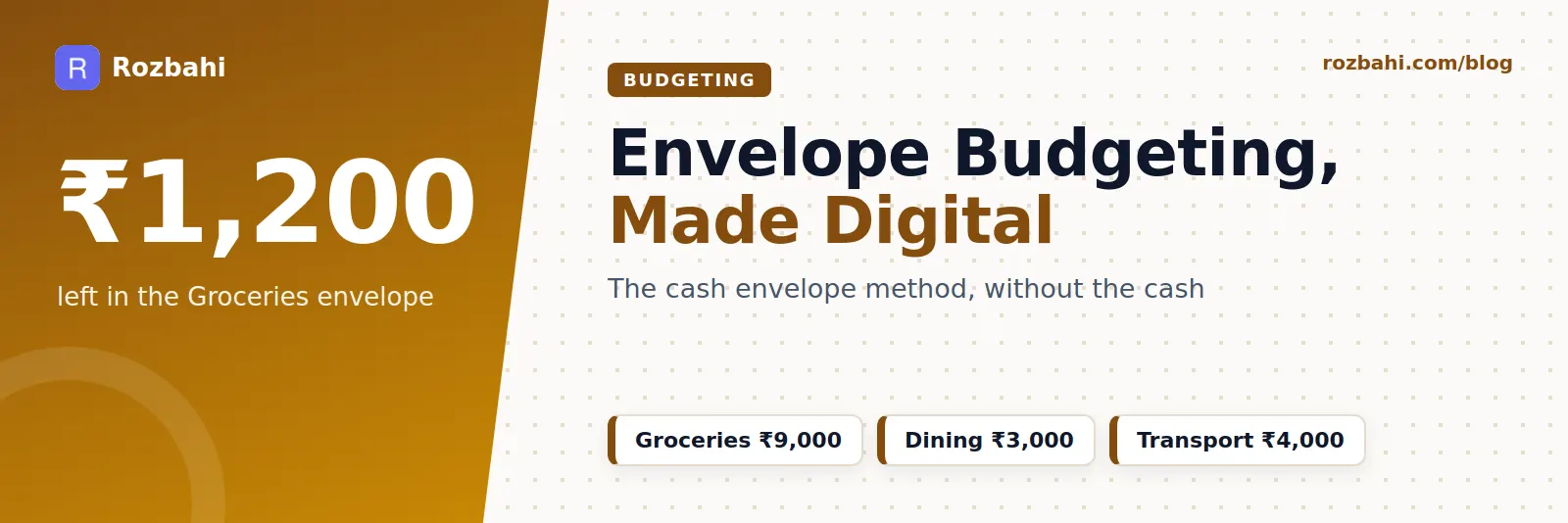
- Groceries: ₹9,000
- Milk and vegetables: ₹4,500
- Dining out and delivery: ₹3,000
- Transport and fuel: ₹4,000
- Shopping: ₹2,500
- Entertainment: ₹1,500
- Miscellaneous: ₹1,500
Set amounts from your real spending, ideally after a month of tracking. Our guide to a monthly household budget explains how.
A month with digital envelopes
By the 20th, the groceries envelope shows ₹7,800 spent and ₹1,200 left. Dining out is at ₹3,000 — empty. Shopping has ₹2,500 untouched. A friend suggests dinner on the 24th. With envelopes, the decision is clear: either skip it, or move ₹800 from shopping to dining out, knowing that shopping is now ₹800 smaller this month. No guilt, no surprise — just a choice made with full information.
What to do with leftover money
At the end of the month, some envelopes will have money left. You have three options:
- Save it. Move it to savings or a goal. This is the most powerful habit of all.
- Roll it over to the same envelope next month, useful for irregular categories like clothes or gifts.
- Reward yourself with a small part, which keeps the system enjoyable.
Whatever you choose, decide on purpose. Unplanned leftovers tend to disappear.
Common envelope budgeting mistakes
- Too many envelopes. Twenty categories are hard to manage; start with five to eight.
- Unrealistic amounts. Envelopes based on hopes, not real spending, run out by the 10th.
- Borrowing between envelopes without noticing. Moving money is fine; doing it automatically defeats the point.
- Forgetting irregular costs. Add an envelope for festivals, gifts and repairs, funded a little each month.
- Not recording small spends. A digital envelope is only accurate if every expense is logged.
Envelopes for couples and families
Envelopes work well for households, because everyone can see what is left. Agree the envelopes and amounts together, and make sure every family member's spending is recorded against the same envelopes. A shared family tracker makes this simple; see our family expense tracker guide.
Envelope budgeting vs other methods
- Compared with 50/30/20, envelopes are more detailed and better for daily decisions. See the 50/30/20 rule.
- Compared with simply tracking, envelopes add limits, which is what turns awareness into control.
- Compared with zero-based budgeting, envelopes focus on the variable categories where most overspending happens, and are quicker to run.
Is envelope budgeting right for you?
Envelopes suit you if you overspend in one or two categories, if you like clear limits, or if a vague bank balance makes it hard to know what you can afford. They are less necessary if your spending is already steady and well below your income. Many people use envelopes for a few months to reset their habits, then relax into simple category budgets.
A quick start in 20 minutes
- Look at last month's spending by category.
- Pick five to eight variable categories as envelopes.
- Set each envelope slightly below last month's real figure.
- Check your envelopes every Sunday, and once more around the 20th.
That is all it takes to begin. Refine the amounts after the first month, once you see which envelopes run out and which have money left.
How to do this in Rozbahi
- Your categories are your envelopes in Rozbahi: Groceries, Milk & Dairy, Vegetables, Food & Dining, Transport, Shopping and more, plus any you add.
- Set a monthly budget for each one. The Budget screen shows how much is spent and the percentage used — your digital envelope.
- Record every expense as it happens, whatever the payment method: cash, UPI or card.
- Moving money between envelopes is simply lowering one budget and raising another.
- At month end, check what is left in each category and decide what to do with it. Rozbahi does not carry leftovers over automatically, so set next month's limits yourself.
- Share envelopes with the family through a family group, so every person's spending counts.
Frequently asked questions
Does envelope budgeting work without cash?
Yes. Digital envelopes — categories with monthly limits and a clear "left" amount — work the same way while you pay by UPI or card.
How many envelopes should I have?
Five to eight for variable spending is a good start. Fixed bills usually stay outside envelopes.
What if an envelope runs out early?
Stop spending in that category, or move money from another envelope on purpose. Next month, adjust the amounts based on what happened.
What do I do with money left in envelopes?
Save it, roll it over for irregular costs, or keep a small part as a reward. Decide on purpose so it does not disappear.
Try digital envelopes: download Rozbahi and set your first category budgets.
Go deeper: Guide: how to make a monthly budget · Feature: budget planner