For families with children, education is one of the largest and most predictable costs — and still one of the most stressful. School fees arrive in big quarterly or yearly instalments, admission season brings a pile of one-time costs, and coaching, books, uniforms and activities keep adding up in between. The good news is that almost all of it can be planned. This guide shows how to list your education costs, turn them into a manageable monthly amount, and track them through the year.
Step 1: List every education cost for the year
- School fees: tuition fees, term fees, annual charges, development fees
- Admission costs: admission fees, registration, security deposits (in admission years)
- Transport: school bus or van
- Books and stationery
- Uniforms and shoes — often more than one set a year
- Coaching and tuition
- Activities: sports, music, art, trips, events
- Devices and internet for study
- Exam fees and competition fees
Step 2: Add up the yearly total
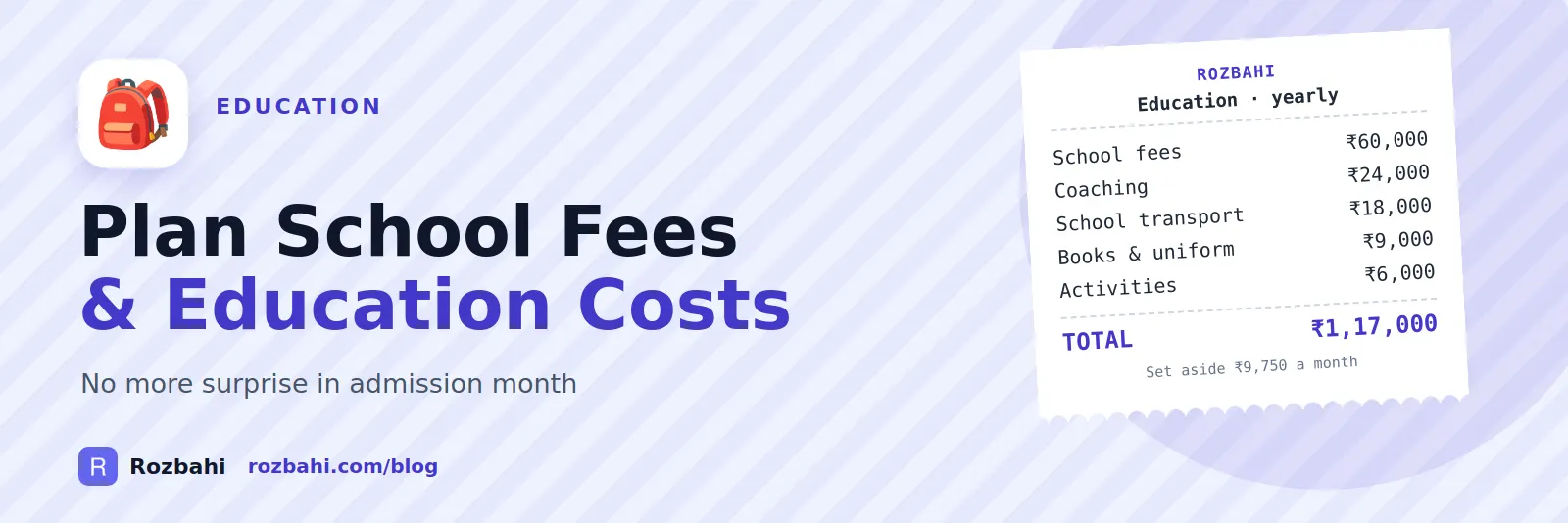
An example for one child for a year:
- School fees: ₹60,000
- Coaching: ₹24,000
- School transport: ₹18,000
- Books and uniform: ₹9,000
- Activities: ₹6,000
Total: ₹1,17,000 a year. Every family's numbers are different; the point is to see the whole year in one place.
Step 3: Turn it into a monthly amount
Monthly education saving = yearly total ÷ 12
In the example, that is ₹9,750 a month. Set this aside every month in a separate account or savings pot. When a ₹20,000 quarterly fee or the June books-and-uniform bill arrives, the money is already there. Without this step, the same costs arrive as shocks and often end up on a credit card.
Step 4: Mark the big dates
Make a simple calendar of when each payment is due: fee instalments, the start of the school year, coaching batches, exam fees, school trips. Seeing the dates in advance lets you check that your education savings will cover each one. See the bill reminder guide for setting up recurring payments.
Admission years need extra planning
Years when a child starts school, changes school, or moves to junior college often carry one-time costs: admission fees, deposits, new uniforms and books, sometimes higher fees. Start saving for these at least a year in advance, as a separate savings goal on top of the regular education amount. See how to set savings goals.
Plan for fee increases
School fees often rise from year to year. When you plan next year, do not assume this year's number — add a cushion for an increase, and check the school's fee notices. Tracking actual education spending each year shows your family's real rate of increase.
Two or more children
With more than one child, list costs for each child separately, then add them up. Years when two children have admission costs together are the toughest; spot them early on your calendar and save more in the years before.
Tax note
Under India's old income tax regime, tuition fees paid for up to two children may qualify for a deduction under Section 80C, within the overall limit. Rules depend on the regime you choose and can change, so check current rules or ask a tax adviser, and keep fee receipts.
Longer-term education goals
College and professional courses cost far more than school. For these, start a separate long-term savings plan as early as possible, ideally with professional advice on suitable investments. The earlier you start, the smaller the monthly amount needed.
Ways to keep education costs in check
- Buy used books or exchange with older students.
- Pass uniforms down between siblings where possible.
- Review coaching and activities each year: keep what helps, drop what does not.
- Compare transport options — a school bus, a shared van, or a carpool with neighbours.
- Use free resources: libraries and good free online lessons.
An education calendar example
- April: first fee instalment, books, stationery and new uniforms — often the most expensive month.
- June–July: new coaching batches; school bags and shoes if needed.
- July: second fee instalment.
- October: third instalment; school trips and events.
- December–January: fourth instalment; exam fees; activities.
- February–March: admission enquiries and registrations for the next year, if changing schools.
Your school's schedule will be different; write your own calendar once and keep it with your budget.
What to ask the school
- What is the total yearly cost, including all fees and charges?
- When is each instalment due, and is there a discount for paying yearly?
- Are books, uniforms and transport extra?
- What is the expected fee increase for next year?
- Are there one-time charges in some classes — board exam fees, lab fees, trips?
Clear answers up front make your plan accurate.
Monthly saving vs paying from salary
Some families pay each instalment straight from that month's salary. That works only if the month has room. Setting aside the monthly education amount in a separate account smooths the year: every month looks the same, and instalment months are no longer stressful. If your school offers a discount for paying the whole year at once, a separate education account also lets you take it.
Talk to children about costs
Older children can understand what their education costs. Sharing the yearly number — without making them feel guilty — helps them value books, take care of uniforms and devices, and make thoughtful choices about coaching and activities. It is also one of the best money lessons a family can give.
The bottom line
List every education cost for the year, divide by 12, set that amount aside every month, mark the payment dates on a calendar and save separately for admission years. Track actual spending so next year's plan uses real numbers. With this in place, admission month and fee instalments become routine instead of stressful — and the money for your child's education is always ready when it is needed.
One more tip: keep every receipt
Keep fee receipts, book bills and coaching receipts in one folder or photographed on your phone. They help with tax claims where they apply, with disputes about payments, and with planning next year accurately. A quick photo on the day you pay takes seconds and saves hours later.
How to do this in Rozbahi
- Use the Education category (शिक्षा) in Rozbahi for all school costs, or add your own, such as "Coaching".
- Add fees as recurring bills — monthly, yearly or every few months with a custom cycle — so each instalment is in your upcoming list.
- Create a savings goal for admission years or college with a target and a date.
- Log one-off costs like books, uniforms and trips as they happen.
- Check your yearly education spending in your reports to plan next year with real numbers.
Frequently asked questions
How do I plan for my child's school fees?
List all yearly education costs, divide by 12, and set that amount aside every month in a separate account.
How much should I save for school admission?
It depends on the school. Ask for the full admission cost in advance and start saving a year ahead as a separate goal.
How can I reduce education expenses?
Reuse books and uniforms, review coaching and activities each year, compare transport options and use free learning resources.
Make admission month calm: download Rozbahi.
Go deeper: Guide: how to make a monthly budget · Feature: budget planner