The bijli bill is one of the few household bills that can double between winter and summer. Air conditioners, coolers, geysers and an always-on fridge quietly add units every day, and many state tariffs charge a higher rate per unit as your usage rises. The good news: a few changes to the biggest power users cut the bill noticeably, without living in discomfort. This guide shows how to find where your electricity goes, what to change first, and how to track the bill month by month.
Step 1: Read your bill
Your electricity bill shows the most important number: units consumed (kWh) for the billing period. Note it, along with the amount. Many state boards charge in slabs — a lower rate for the first block of units, higher rates after that — plus fixed charges and taxes. Because of slabs, cutting the units at the top of your usage saves more than you might expect. Tariffs differ by state and change over time, so use your own bill as the reference.
Step 2: Find your biggest power users
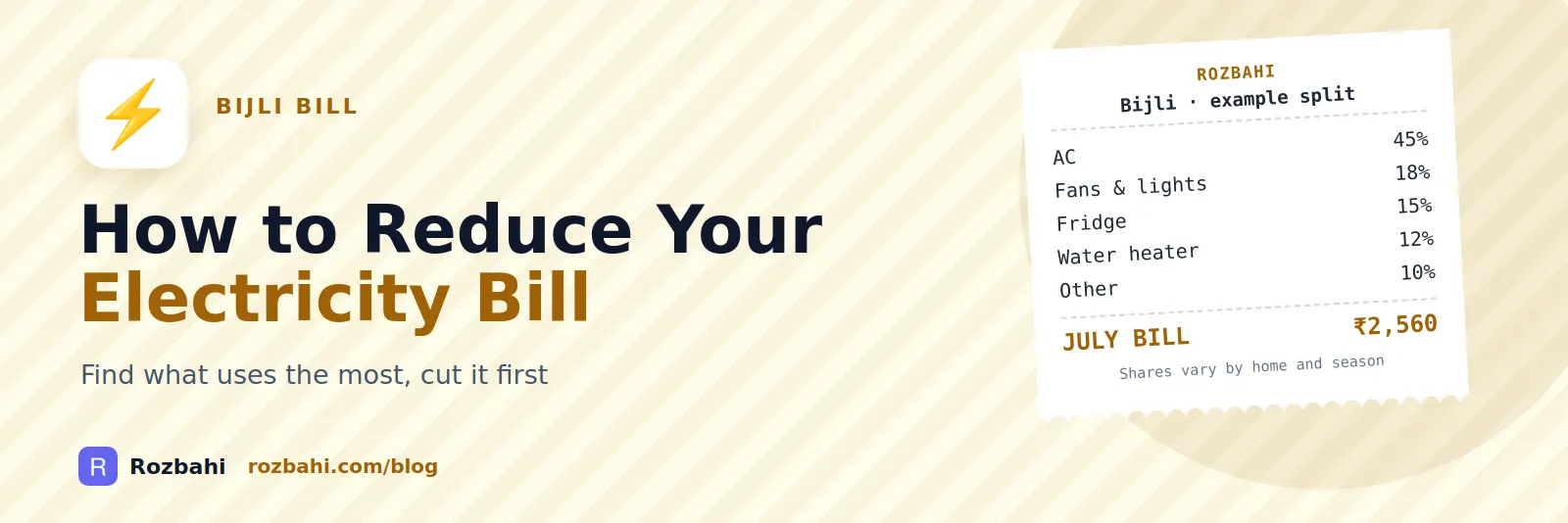
In most homes a few appliances use most of the electricity. A rough idea of where power goes in a typical summer month for a home with one AC might be: AC around 45%, fans and lights around 18%, fridge around 15%, water heater around 12%, and everything else around 10%. These shares vary a lot by home and season — in winter, the geyser may lead instead. Your bill's units in summer versus winter tell you how much seasonal appliances add.
Air conditioner: the biggest lever
- Set it to 24°C or higher. In India, 24°C is the recommended default for ACs, and each degree warmer saves energy.
- Use a fan with the AC so a higher temperature still feels cool.
- Close doors and windows, and use curtains to block afternoon sun.
- Clean the filters every few weeks in season.
- Use the timer or sleep mode so it does not run all night at full power.
- Service it before summer so it runs efficiently.
Water heater (geyser)
- Do not leave it on all day. Switch it on 15–20 minutes before you need hot water, or use a timer.
- Lower the thermostat if it has one.
- Consider a solar water heater if you own your home and have roof space.
Fridge
- Keep it away from the wall and away from the stove or direct sun.
- Do not put hot food inside; let it cool first.
- Check the door seal; a weak seal leaks cold air all day.
- Do not open the door longer than needed.
Lights, fans and small appliances
- Switch to LED bulbs and tube lights — they use a fraction of the power of old bulbs.
- Consider energy-efficient (BLDC) fans when replacing old ones; fans run for many hours a day.
- Switch off at the plug: TVs, set-top boxes, chargers and microwaves draw standby power.
- Run washing machines and dishwashers full.
- Iron clothes in one batch rather than piece by piece.
Buying new appliances
When you replace an AC, fridge, geyser or fan, check the BEE star rating. A higher star rating usually costs more upfront but uses less electricity for years. For appliances that run many hours a day, the savings on your bill can make up the price difference over time.
Step 3: Track your bill every month
Record each electricity bill with its units and amount. After a few months you will see your seasonal pattern clearly — for example, summer bills two or three times winter bills. That helps in two ways: you can set aside more in the expensive months, and you can see whether your changes are working. Compare each month with the same month last year for the fairest comparison.
Electricity in your budget
Because the amount varies, treat electricity as a semi-fixed bill: plan for it every month, but confirm the actual amount when the bill comes. See fixed vs variable expenses and the bill reminder guide.
A simple summer plan
- Before summer: service the AC, clean filters, check the fridge seal, and switch remaining old bulbs to LED.
- Every day: AC at 24°C or higher with a fan, curtains closed in the afternoon, geyser off.
- Every night: timer or sleep mode on the AC; switch off TVs and set-top boxes at the plug.
- Every bill: note the units, compare with last year's same month, and adjust.
Cooler or AC?
In dry, hot weather, an air cooler uses much less electricity than an AC and can keep rooms comfortable. In humid weather, coolers work less well. Many homes use a cooler in the drier months and the AC only on the hottest, most humid days or only in the bedroom at night. Track your bills across a season to see what the mix costs you.
Common electricity bill myths
- "Switching the AC on and off saves more than keeping it on." Not always — frequent switching in a hot room can make it work harder. Use a sensible temperature and a timer instead.
- "Standby power is negligible." One device is small; a house full of devices on standby every hour of the year adds up.
- "New appliances always save money." Only if they are more efficient and you would replace the old one anyway. Check the star rating.
Involve the whole family
Electricity is used by everyone, so savings work best when everyone joins in. Share the monthly bill with the family, agree a few simple rules — lights off when leaving a room, AC at 24°C, geyser off after use — and show the next bill's result. Children especially enjoy seeing the units go down.
The bottom line
Find your biggest power users, start with the AC and geyser, cut standby waste, choose star-rated appliances when replacing, and track units every month. Small changes, done consistently, show up clearly on the next bill.
Start with this month’s bill: note the units today, make two changes, and compare next month.
How to do this in Rozbahi
- Add electricity as a recurring bill in Rozbahi under Bills & Utilities (बिल), monthly or on your billing cycle.
- Use confirm mode so Rozbahi asks you for the real amount each time.
- Add the units in the note (for example "July — 320 units") to compare usage over time.
- Check the monthly report to see Bills & Utilities and the change from last month.
- Set a budget for bills in the summer months so the jump does not surprise you.
Frequently asked questions
What uses the most electricity at home?
Usually air conditioners in summer and water heaters in winter, followed by fridges, fans and lights that run for long hours.
Does setting the AC at 24°C save electricity?
Yes. A warmer setting means the AC works less. Using a fan alongside lets you stay comfortable at a higher temperature.
Do appliances use electricity when switched off?
Many use a small amount on standby. Switching off at the plug avoids it.
How can I check if my electricity bill is correct?
Compare the units on the bill with your meter reading, and compare with the same month last year. Contact your electricity board if something looks wrong.
Track your bijli bill every month: download Rozbahi.
Go deeper: Guide: household expense categories · Feature: recurring bills