Petrol is one of those expenses that feels small at the pump and large at the end of the month. ₹500 here, ₹1,000 there — and few people know what their daily commute actually costs, or how much a weekend trip adds. A simple fuel expense calculation answers both. This guide gives you the formula, worked examples for a bike and a car, and practical ways to bring the fuel bill down.
The fuel cost formula
Fuel used (litres) = distance (km) ÷ mileage (km per litre)
Fuel cost = fuel used × price per litre
Cost per km = price per litre ÷ mileage
That is all you need. The trick is knowing your real mileage, not the brochure figure.
Worked example: a bike
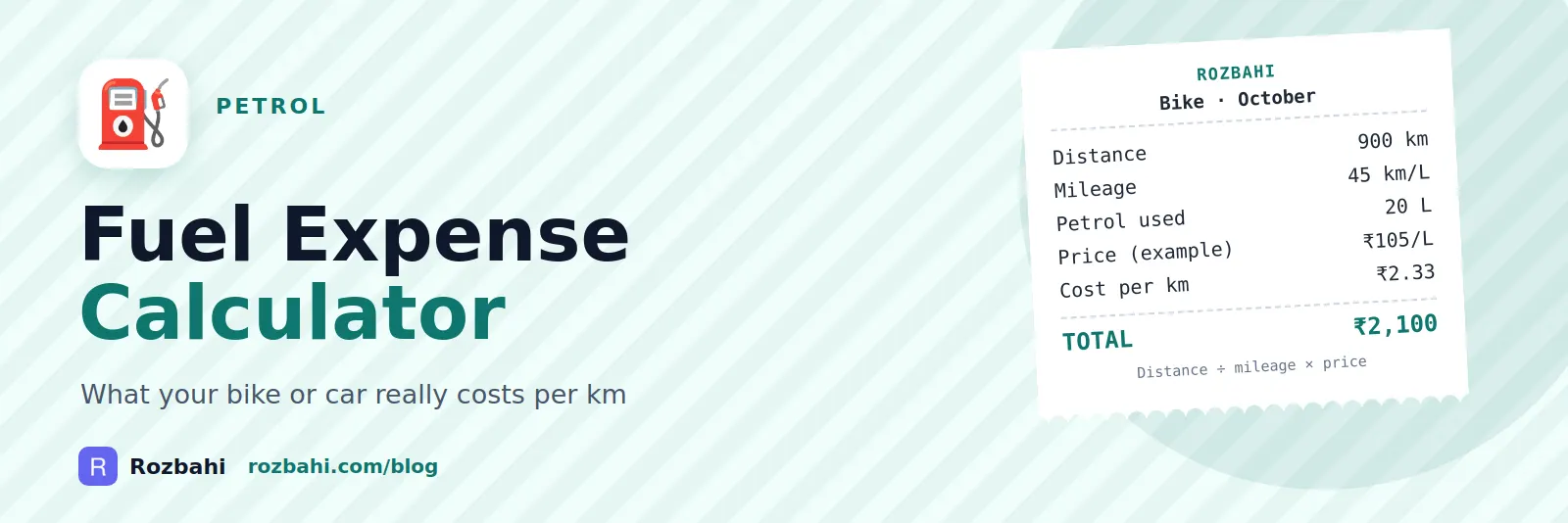
- Distance in October: 900 km
- Mileage: 45 km per litre
- Petrol price (example): ₹105 per litre
Fuel used: 900 ÷ 45 = 20 litres. Fuel cost: 20 × ₹105 = ₹2,100. Cost per km: ₹105 ÷ 45 = ₹2.33. Fuel prices differ by city and change often, so always use the price you actually paid.
Worked example: a car
- Distance in a month: 1,200 km
- Mileage: 15 km per litre
- Petrol price (example): ₹105 per litre
Fuel used: 1,200 ÷ 15 = 80 litres. Fuel cost: 80 × ₹105 = ₹8,400. Cost per km: ₹105 ÷ 15 = ₹7.00.
How to find your real mileage
- Fill the tank completely and note the odometer reading.
- Drive normally until the tank is around a quarter or half.
- Fill the tank completely again and note the litres added and the new odometer reading.
- Mileage = km driven ÷ litres added.
Repeat two or three times and average the results. City traffic, tyre pressure, load and driving style all change mileage, so your real number is often lower than advertised.
Fuel is only part of the cost
For a full picture of what a vehicle costs, add:
- Servicing and repairs
- Insurance (yearly premium ÷ 12)
- Parking and tolls
- Tyres and batteries over time
- Loan EMI, if any
Tracking these alongside fuel shows your true cost per month and per km.
Compare your commute options
Once you know your cost per km, comparing options becomes simple. A 20 km round-trip commute on the example bike costs about ₹47 a day in petrol; in the example car, about ₹140. Compare that with the metro, bus, a carpool or an office shuttle. Sometimes the cheapest option is not the obvious one, and sometimes a mix — bike on some days, metro on others — works best.
Ways to cut your fuel bill
- Keep tyres at the right pressure — under-inflated tyres waste fuel.
- Service on time: clean air filters and correct engine oil help mileage.
- Drive smoothly: gentle acceleration and steady speeds use less fuel than sudden starts and stops.
- Switch off at long signals and in long waits.
- Remove extra weight from the boot.
- Combine errands into one trip.
- Carpool or use public transport on some days.
Fuel in your monthly budget
Fuel is a variable expense that is easy to under-count, because it is paid in many small top-ups. Record every fill-up, set a monthly fuel budget based on your real average, and check it weekly. See how to make a monthly household budget.
A quick fuel cost table
Cost per km at an example price of ₹105 per litre:
- Mileage 60 km/L (efficient commuter bike): about ₹1.75 per km
- Mileage 45 km/L (typical bike): about ₹2.33 per km
- Mileage 35 km/L (scooter or bigger bike): about ₹3.00 per km
- Mileage 20 km/L (small car): about ₹5.25 per km
- Mileage 15 km/L (mid-size car): about ₹7.00 per km
- Mileage 10 km/L (large car or SUV in city): about ₹10.50 per km
Use your own price and mileage for exact numbers.
Plan a road trip budget
The same formula plans a trip. For a 600 km return journey in a car that does 15 km per litre, fuel needed is 600 ÷ 15 = 40 litres. At ₹105 per litre, that is ₹4,200. Add tolls, parking and a buffer for city driving at the destination. If friends share the ride, the cost per person drops sharply; see how to split trip expenses.
Watch your mileage over time
If your mileage drops noticeably compared with your usual average, something has changed: tyre pressure, a due service, a dragging brake, or more city traffic. Checking mileage every few fill-ups gives an early warning, and often a cheap fix saves fuel for months.
Two-wheeler or car: what it really costs
For a daily commute, the gap between a bike and a car can be several thousand rupees a month in fuel alone, before parking and maintenance. That does not mean the bike is always the right choice — safety, weather, family needs and distance matter. But knowing the real cost per km helps you decide when to take which, and when public transport or a carpool is the better deal.
Electric and CNG vehicles
If you are thinking about an electric or CNG vehicle, compare cost per km the same way: energy or fuel price divided by the distance it gives you. For electric, use your electricity tariff and the vehicle's kilometres per unit; for CNG, the price per kg and kilometres per kg. Add the purchase price difference and maintenance to see when, if ever, the switch pays back.
The bottom line
Distance divided by mileage gives litres; litres times price gives cost. Find your real mileage with the full-tank method, record every fill-up, add servicing, insurance, parking and tolls for the full picture, and compare commute options by cost per km. Once you know what every kilometre costs, it becomes much easier to decide how to travel — and to keep the monthly fuel bill under control.
One more tip: fill up at the same pump
Filling up at the same pump and noting litres and odometer each time makes your mileage numbers more consistent and easier to compare. Many people also find it helps to fill a fixed amount or a full tank rather than random top-ups, so each fill-up is easy to read in their records.
How to do this in Rozbahi
- Log every fill-up in Rozbahi under Fuel (ईंधन), with the petrol pump as the vendor and the odometer reading or litres in the note.
- Log servicing, parking and tolls under Transport so you see the full cost of the vehicle.
- Set a monthly Fuel budget and watch the percentage used.
- Check the monthly report for fuel and transport totals and the change from last month.
- Use templates for regular costs like a fixed parking charge.
Frequently asked questions
How do I calculate petrol cost per km?
Divide the price per litre by your mileage in km per litre. At ₹105 per litre and 45 km per litre, it is about ₹2.33 per km.
How do I calculate my monthly fuel expense?
Divide the distance you drive in a month by your mileage to get litres, then multiply by the price per litre — or simply add up every fill-up for the month.
How can I check my bike's real mileage?
Use the full-tank method: fill up, note the odometer, drive, fill up again, and divide kilometres driven by litres added.
Know what every km costs: download Rozbahi.
Go deeper: Guide: household expense categories · Feature: recurring bills