"How much should we spend on groceries?" is one of the most searched money questions, and the honest answer is: it depends. City, family size, diet, how often you cook and where you shop all change the number. What does not change is the method for finding the right grocery budget per month for your family. This guide gives you that method, with examples and a simple weekly check to keep it on track.
Why averages do not help much
National averages mix big cities with small towns, vegetarian with non-vegetarian homes, and families who cook every meal with those who order in. Your grocery bill can be half or double an average and still be perfectly reasonable. The only number that really helps is your own, measured for a month or two.
Step 1: Decide what counts as groceries
Before measuring, agree on the boundaries, or the numbers will not be comparable month to month:
- Usually in groceries: staples (rice, atta, dal, oil), packaged food, spices, snacks, beverages, cleaning and toiletries bought with food.
- Often tracked separately: milk and dairy, vegetables and fruit — these are bought daily and are easier to control as their own categories.
- Not groceries: eating out, food delivery and prepared meals; these belong in dining.
Step 2: Measure one to two months
Record every grocery purchase, big and small, including quick top-up orders. At the end, you will see two useful numbers: your monthly total, and how many separate trips or orders it took. Both matter. More trips almost always means a bigger bill.
Step 3: Use a per-person check
Divide your monthly grocery total by the number of people eating at home most days (count small children as half). This gives a per-person cost that you can compare across months, even when guests visit or someone is away. If the per-person number jumps, something changed — prices, habits or where you shop.
Step 4: Set the budget
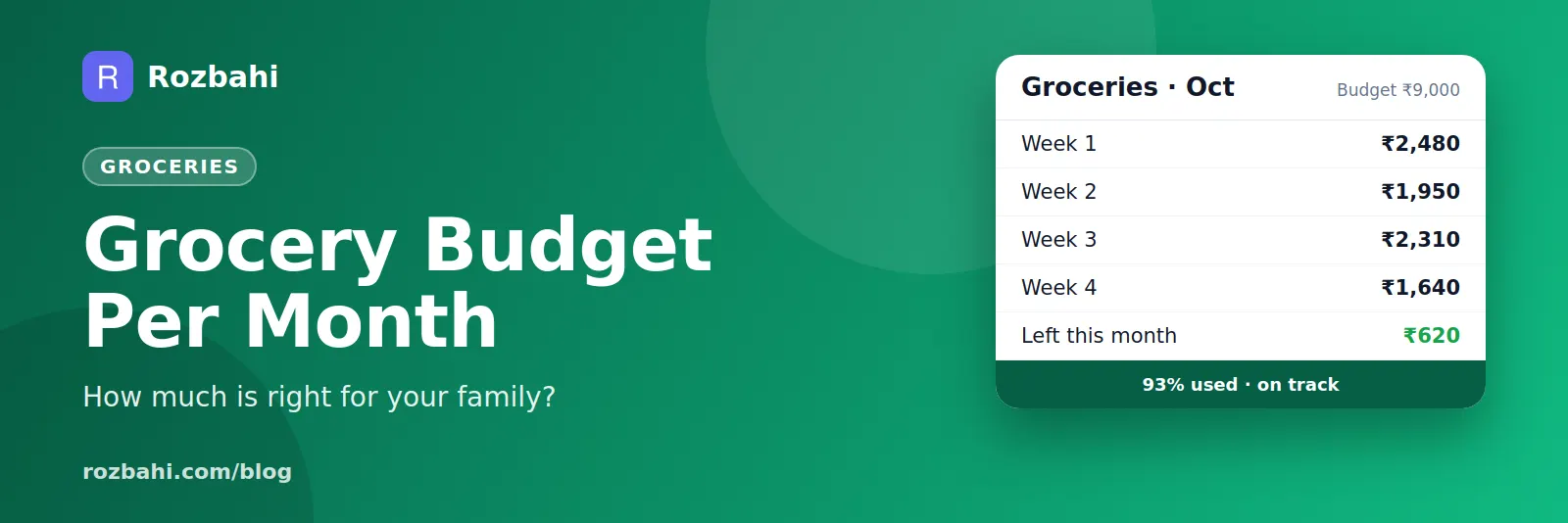
Take your measured average and set the budget about 5–10% below it. That is enough to encourage planning without feeling like a diet. Then split it between a monthly stock-up and weekly top-ups: a ₹9,000 grocery budget could be a ₹3,000 stock-up of staples at the start of the month plus about ₹1,500 a week for fresh items and top-ups.
A worked example
A family of four (two adults, two children aged 6 and 10) tracks groceries for two months:
- Month 1: ₹9,840 across 17 trips and orders
- Month 2: ₹9,360 across 15 trips and orders
- Average: ₹9,600; people counted: 2 + 0.5 + 1 = 3.5; per person: about ₹2,740
They set a ₹9,000 budget (about 6% lower) and plan one big monthly shop plus one weekly top-up. In month three, weekly spending comes to ₹2,480, ₹1,950, ₹2,310 and ₹1,640 — ₹8,380 in total, ₹620 under budget, with 10 trips instead of 17.
Step 5: Check weekly
A monthly grocery budget fails quietly in week three. A quick weekly check prevents that:
- How much of the month's grocery budget is used?
- Is it ahead of the calendar? (50% used by the 15th is on track; 70% is not.)
- If ahead, plan meals from what is already at home for a few days.
What pushes grocery bills up
- Frequent small trips and quick-delivery orders, each adding impulse items and fees.
- No list, or a list that is ignored.
- Shopping hungry.
- Wasted food: vegetables that go bad, leftovers thrown away.
- Brand loyalty on basics where store brands are just as good.
For practical ways to bring the number down, read how to save money on groceries.
Grocery budget for different households
- Single person: often a higher per-person cost, because packs are sized for families and food gets wasted. Buying smaller quantities more carefully helps.
- Couple: plan meals together and shop once a week.
- Family with children: snacks and school tiffin items can be a hidden category; track them.
- Joint family: bulk buying of staples saves money; track who buys what in a shared group.
Grocery budget as a share of income
Another useful check is how much of your take-home income goes on food at home. It varies a lot by country and income level: in lower-income households food can take a large share of the budget, while in higher-income households it is usually a smaller share. Rather than chasing a universal percentage, watch your own share over time. If groceries take a growing share of income while your family size has not changed, prices or habits are pushing it up, and it is worth a closer look.
Plan meals, plan the budget
The cheapest grocery trip is the one you planned. A simple weekly meal plan does not need to be fancy:
- On the weekend, list dinners for the week, using what is already in the kitchen first.
- Write the shopping list from the plan, grouped by section of the store.
- Buy staples monthly, fresh items weekly, and avoid in-between trips.
- Cook a little extra twice a week for next-day lunches.
When prices rise
Food prices change through the year — vegetables in particular swing with the season, and staples rise with inflation. When your grocery total jumps, check whether it is price or quantity before cutting. Your tracker helps: if you bought the same items but paid more, prices rose and the budget may need a small increase. If you bought more items, habits changed, and planning is the fix.
Signs your grocery budget is right
- You finish most months within budget without feeling short of food.
- Food waste is low; little goes in the bin at the end of the week.
- Top-up trips are rare and planned.
- The per-person cost is steady from month to month.
The bottom line
The right grocery budget is the one built from your own numbers: measure for a month or two, set a target slightly below the average, split it into a stock-up and weekly top-ups, and check it every week. That simple loop works for any family, in any city.
Give it two months before judging. The first month finds the number; the second shows whether planning brings it down.
How to do this in Rozbahi
- Use the ready-made categories in Rozbahi: Groceries, Milk & Dairy, Vegetables and Fruits, so daily items do not hide inside one big number.
- Log every trip and order, with the shop name in the vendor field.
- Set a monthly budget for each category; the Budget screen shows what is spent and the percentage used.
- Check the monthly report for category totals, your top shops and the change from last month.
- Share with the family so groceries bought by anyone count toward the same budget.
Frequently asked questions
How much should a family of four spend on groceries?
It varies widely by city and diet. Measure your own spending for one or two months, then set a budget 5–10% below that average.
Should milk and vegetables be part of the grocery budget?
You can include them, but tracking them as separate categories makes daily spending easier to see and control.
Is it better to shop weekly or monthly?
A monthly stock-up for staples plus one weekly trip for fresh items usually costs less than many small trips.
Find your real number: download Rozbahi and track groceries for one month.
Go deeper: Guide: household expense categories · Feature: recurring bills