For many families, milk is the only bill that arrives every single day. The monthly doodh ka hisab looks simple: litres per day, times the rate, times the number of days. In practice, an extra half-litre for guests, two days away, a holiday for the milkman and a price rise in the middle of the month turn it into an argument. This guide gives you the formula, a worked example and a simple way to keep the hisab exact.
The basic milk bill formula
Milk bill = litres per day × rate per litre × days delivered
Then adjust for:
- Extra milk: add extra litres × rate for those days.
- Skipped days: do not count days with no delivery.
- Less milk: for days with a smaller quantity, use the actual litres.
- Rate change: calculate the days before and after the change separately.
A worked example
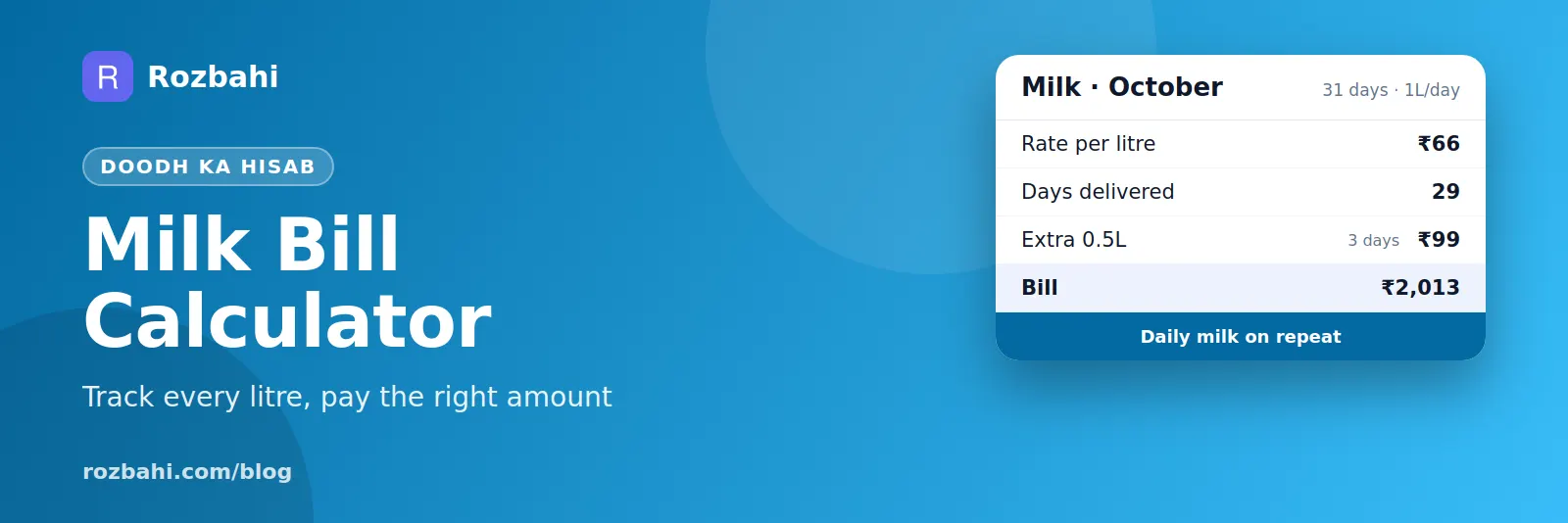
October has 31 days. You take 1 litre a day at ₹66 per litre.
- No delivery for 2 days while you were away: 29 days delivered.
- Regular milk: 29 × 1 litre × ₹66 = ₹1,914
- Extra half-litre on 3 days for guests: 1.5 litres × ₹66 = ₹99
- Total bill: ₹2,013
If the rate went up from ₹64 to ₹66 on the 16th, split the month: days 1–15 at ₹64 and days 16–31 at ₹66, minus the skipped days in each part.
Common milk bill mistakes
- Counting calendar days instead of delivery days.
- Forgetting extra packets taken for festivals or guests.
- Using the new rate for the whole month after a mid-month price rise.
- Mixing up packet sizes: 500 ml, 1 litre and loose milk by the litre.
The easier way: record it every day
A calculator at month end works, but only if you remember every skipped and extra day. Recording milk daily removes the guesswork. Keep a calendar on the fridge, or use an app that adds the regular amount automatically and lets you change the exceptions.
Packet milk vs loose milk
How you calculate depends on how you buy:
- Packet milk (500 ml or 1 litre packets from a dairy or a delivery app): the price is per packet. Count packets per day, multiply by the packet price and the days delivered.
- Loose milk from a gwala: the price is per litre, and quantities like 1.5 litres are common. Multiply litres by the rate per litre.
- Subscription apps charge from a wallet each day. The app shows a history, but it is still worth recording the monthly total in your own hisab so it sits next to the rest of your spending.
Milk bill calculation table
A quick reference for a 30-day month at common rates:
- 500 ml a day at ₹33 per packet: ₹990
- 1 litre a day at ₹66 per litre: ₹1,980
- 1.5 litres a day at ₹66 per litre: ₹2,970
- 2 litres a day at ₹60 per litre (loose): ₹3,600
- 2 litres a day at ₹66 per litre: ₹3,960
For a 31-day month, add one more day. Subtract any days with no delivery and add extra packets separately.
Settling the hisab with the milkman
- Agree the rate in advance and note the date of any price change.
- Keep a daily record of extra or skipped days on your side, not only on his card.
- Compare totals before paying. If his bill and yours differ, the difference is usually one or two extra or skipped days, easy to find in a daily record.
- Pay on a fixed date each month, and record the payment.
How much milk does a family use?
Usage varies with diet, children and how much tea and curd is made at home. A typical pattern is about 250–500 ml per person per day. A family of four often uses 1 to 2 litres a day — roughly ₹2,000 to ₹4,000 a month at common rates, which makes milk one of the biggest regular food costs in many Indian homes. That is why tracking it exactly is worth it.
Track curd, paneer and ghee too
Milk is only part of the dairy bill. Curd, paneer, butter and ghee often come from the same dairy and are added to the same card. Record them in the same category so your monthly dairy total is complete. If you buy them separately from a shop, add them as normal expenses in Milk & Dairy. At month end you will see the real cost of dairy for your family, not just the milk.
What to do when the rate changes
Milk prices change once or twice a year in many cities, often by ₹2 to ₹4 per litre. When it happens:
- Note the date the new rate starts.
- Update your recurring milk entry to the new amount from that date. Entries already recorded keep the old price.
- When you check the milkman's bill for that month, make sure the days before the change are at the old rate.
A ₹2 rise on 1.5 litres a day is about ₹90 more each month, or more than ₹1,000 a year. Small, but worth knowing when you plan your budget.
Milk on holidays and festivals
Festivals often mean extra milk for sweets, kheer and guests. Rather than guessing at month end, add each extra packet as its own entry on the day. If you are away, pause the recurring milk entry and resume it when you are back, so the bill and your hisab stay the same.
Quick summary
Count delivery days, not calendar days. Multiply litres by the rate, add extras separately, split the month at any price change, and keep your own daily record to compare with the milkman's bill. A daily recurring entry with skip and pause does most of this for you, and your monthly report shows the exact dairy total.
The same method works for any daily delivery: newspaper, water cans or bread. One recurring entry each, and the month adds itself up.
How to do this in Rozbahi
- Create a daily recurring entry in Rozbahi: "Doodh 1L", ₹66, category Milk & Dairy, every day.
- Choose auto mode so it is added every morning, or confirm mode if the quantity changes often.
- Skip a day when there is no delivery, and pause it while you are travelling.
- Add extras as a separate entry, or save a template "Extra 500ml ₹33" for one tap.
- Change the amount when the rate goes up; earlier days keep the old price.
- At month end, the report shows your exact Milk & Dairy total to match with the milkman's bill.
The same approach works for the newspaper, the water can or the dhobi. See the full ghar ka hisab guide.
Frequently asked questions
How do I calculate my monthly milk bill?
Multiply litres per day by the rate per litre and by the number of days milk was delivered. Then add extra milk and use the right rate for each part of the month.
How do I handle days when the milkman did not come?
Do not count them. In Rozbahi, skip that day's entry so the total stays correct.
Can I track milk from two different sources?
Yes. Create two recurring entries, for example "Dairy packet" and "Gwala loose milk", both in the Milk & Dairy category, each with a clear label.
Keep your doodh ka hisab exact: download Rozbahi.
Go deeper: Guide: household expense categories · Feature: recurring bills