Few things disrupt a household like the gas running out in the middle of cooking dinner. The question "how long does a gas cylinder last?" has no single answer — it depends on your family size, what you cook and how you cook it. But you can find your answer quickly, and once you know it, you can book on time, plan the cost and never be caught without gas again. This guide shows how.
How long does a 14.2 kg cylinder usually last?
The standard domestic LPG cylinder in India holds 14.2 kg of gas. How long it lasts varies widely:
- Single person or couple cooking lightly: often well over a month, sometimes two.
- Family of four cooking two or three meals a day: commonly somewhere around one to one and a half months.
- Large or joint family, or lots of slow cooking: it can be closer to three weeks.
These are rough ranges. Your own kitchen is the only reliable guide, and finding your number takes just two cylinders.
Find your number: the two-cylinder method
- Note the date you connect a new cylinder.
- Note the date it runs out.
- Count the days in between.
- Repeat once with the next cylinder and take the average.
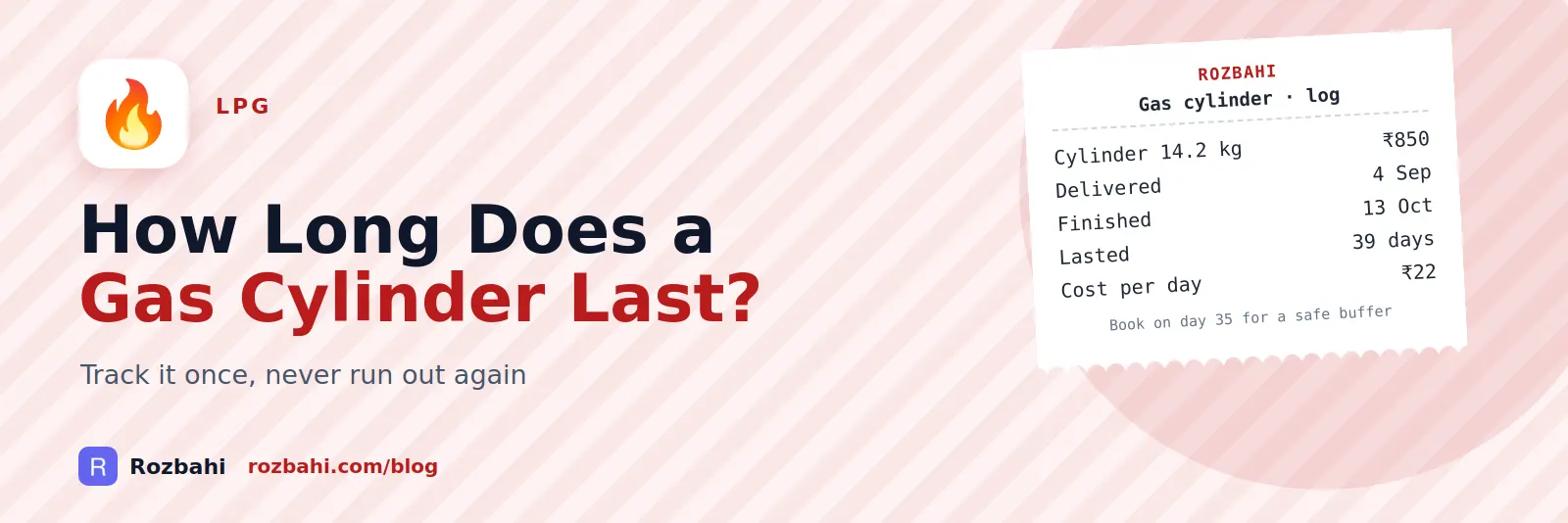
Example: a cylinder delivered and connected on 4 September runs out on 13 October — 39 days. The next one lasts 37 days. Your number is about 38 days.
Calculate your cost per day
Cost per day = cylinder price ÷ days it lasts
If a cylinder costs ₹850 (prices differ by city and change over time) and lasts 39 days, gas costs about ₹22 a day, or roughly ₹650 a month. Knowing the daily cost makes it easier to compare with induction or other options, and to plan your monthly budget.
Book before it runs out
Delivery can take a few days, longer around festivals. Once you know your number, book a few days before the cylinder is due to finish. If your cylinder lasts about 39 days, booking on day 35 gives a safe buffer. Families with a second cylinder can book when they switch to the spare; families with one cylinder should be extra careful about timing.
Signs the cylinder is running low
- The flame becomes weaker or turns more yellow
- The cylinder feels noticeably lighter when gently tilted
- Cooking takes longer than usual
Some people use a hanging scale or a cylinder gauge; the simplest method is still to know your average number of days.
Ways to make your gas last longer
- Use a pressure cooker for dal, rice and vegetables — it cooks much faster.
- Soak dals and rice before cooking.
- Cover pans with a lid to keep the heat in.
- Match the flame to the pan — flames licking up the sides waste gas.
- Keep burners clean so the flame stays blue and efficient.
- Bring food to room temperature before cooking instead of cooking straight from the fridge.
- Use the right-size burner for small pans.
- Turn off a little early for foods that keep cooking in their own heat.
Safety basics
- Turn off the regulator when the kitchen is not in use, especially at night and when travelling.
- Check the rubber tube regularly and replace it if it is cracked or old.
- If you smell gas, do not switch any electrical switch on or off; open windows, turn off the regulator and contact your gas distributor's emergency number.
- Keep the cylinder upright and in a well-ventilated place.
LPG in your monthly budget
Gas is a recurring bill, but on its own cycle rather than monthly. Some months have one cylinder, some months two. Budgeting with the daily cost — ₹22 × 30 days in the example — smooths it out. Our guide to fixed vs variable expenses and the bill reminder guide cover how to handle bills like this.
Why your cylinder runs out faster sometimes
- Guests and festivals: more cooking, more frying, more tea.
- Winter: more hot water, soups and tea, and food takes longer to heat.
- Slow cooking: long boiling, frequent reheating, or open pans.
- A leak or a faulty regulator: if the cylinder runs out much faster than usual with no change in cooking, get the connection checked by your distributor.
- More people at home: holidays, work from home, or a relative staying over.
Tracking each cylinder's dates shows these patterns clearly, so you can book earlier in busy months.
Gas cylinder vs induction: comparing costs
Some families use an induction cooktop alongside gas for tea, milk or quick dishes. To compare costs fairly, work out your gas cost per day from your cylinder log, then check your electricity bill before and after you start using induction. The right mix depends on your gas price, your electricity tariff and what you cook. The key is to measure both rather than guess.
Single cylinder vs double cylinder connection
With a single cylinder, timing is everything: you must book early enough that the new one arrives before the old one finishes. With a double cylinder connection, you switch to the spare when one runs out and book immediately, so you always have a buffer. Either way, knowing your average number of days removes the guesswork.
Keep a simple cylinder log
A log needs only three columns: date connected, date finished, number of days. After a few cylinders, you will know your average, your busy months, and your real yearly cost of cooking gas.
The bottom line
Track two cylinders to learn your average, calculate the cost per day, book a few days before the expected end, cook a little smarter to stretch each cylinder, and keep gas in your monthly budget. You will never be caught without gas in the middle of dinner again.
Start with the cylinder you are using right now: write down the date it was connected, and you are already halfway to knowing your number.
Small habits, big peace of mind.
How to do this in Rozbahi
- Add a recurring bill in Rozbahi for the gas cylinder, under Bills & Utilities, with a custom cycle in days — for example every 38 days — and the price.
- Choose confirm mode so Rozbahi asks you on the due date and you can enter the actual price.
- See it in your upcoming bills, sorted by next date — a reminder to book a few days ahead.
- Adjust the cycle once you know your real average, and skip a cycle if a cylinder lasted longer.
- Check the monthly report to see what gas costs you in Bills & Utilities over the year.
Frequently asked questions
How many days does a 14.2 kg gas cylinder last for a family of 4?
Commonly around one to one and a half months, but it varies with cooking habits. Track two cylinders to find your own number.
How do I know when my gas cylinder will finish?
Note the connection date and divide your past cylinders' days to get an average. Book a few days before that date.
How can I save cooking gas?
Use a pressure cooker, soak dals and rice, cover pans, keep burners clean and match the flame to the pan size.
Never run out of gas again: download Rozbahi.
Go deeper: Guide: household expense categories · Feature: recurring bills