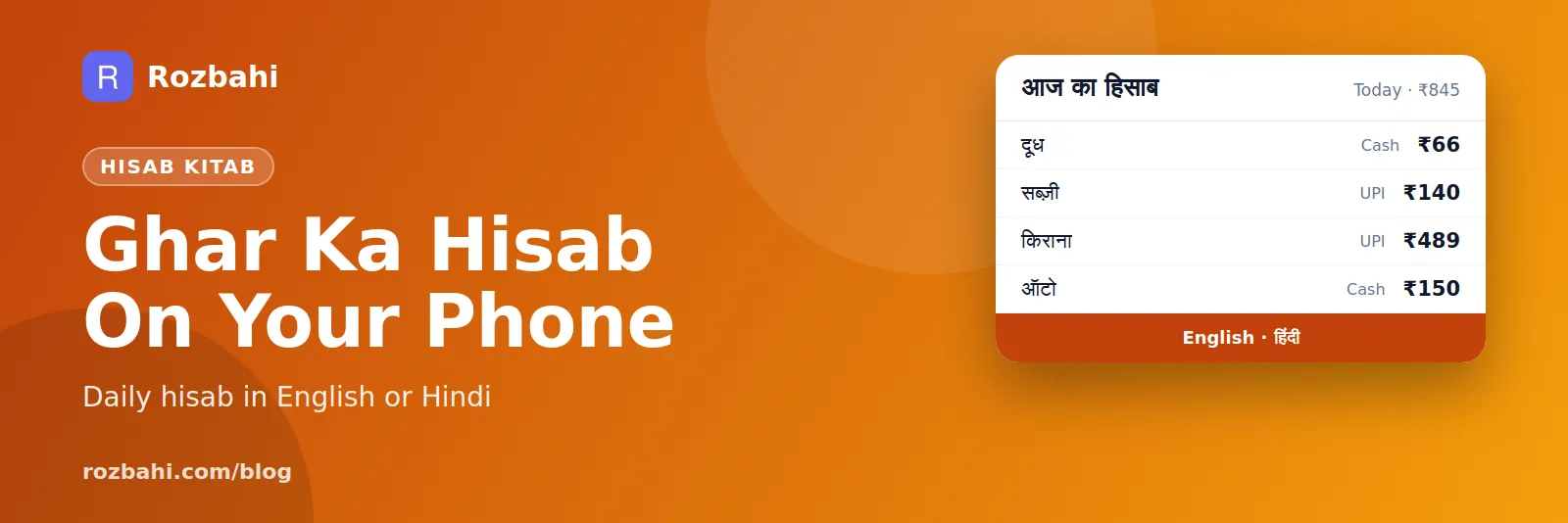
Many Indian homes still have a hisab diary: a notebook in the kitchen drawer where doodh, sabzi, kirana and the dhobi are written down every day. It works because it is simple. The trouble starts at month end, when someone has to add up thirty pages, and when two people in the house keep separate diaries. A hisab kitab app keeps the same daily habit and does the adding for you.
What goes into a ghar ka hisab
A typical household hisab has the same few items every month:
- Doodh (milk), often daily, from a dairy or a milkman
- Sabzi and phal (vegetables and fruit), from the market or a thela
- Kirana (groceries) from the local store or a big monthly shop
- Bills: bijli, paani, gas cylinder, Wi-Fi, mobile recharge
- Kiraya (rent), school fees, maid and dhobi
- Petrol, auto and bus fare
- Medicines, doctor visits and festival spending
Diary vs app: what changes
- Totals are automatic. No adding columns at month end.
- Categories. You can see how much went on doodh or kirana this month in one look.
- Repeat entries. Daily doodh or the monthly rent can be added once and repeat on their own.
- Whole family, one hisab. Everyone can add from their own phone.
- Nothing gets lost. A synced, backed-up hisab survives a lost phone; a wet diary does not.
A simple daily routine
- Write it when you pay. Amount, category, and a word if needed ("Sharma kirana", "auto station").
- Tag how you paid: cash, UPI or card. Cash is the one people forget.
- Once a week, check your UPI history for anything you missed.
- At month end, look at the total and the top three categories, and compare with last month.
For more detail on the habit itself, read how to track daily expenses.
Keep the doodh hisab exact
Milk is the most common daily entry, and the one most often disputed with the milkman: was it 29 days or 30, and how many days were extra? Our guide to the milk bill calculator shows how to keep it exact.
Ghar ka hisab categories, in Hindi and English
Using the same names every month makes your hisab easy to compare. These are the everyday categories Rozbahi starts with, in both languages:
- दूध और डेयरी (Milk & Dairy) — milk, curd, paneer, ghee
- किराना (Groceries) — atta, dal, rice, oil, masale, sugar, tea
- सब्ज़ियाँ (Vegetables) and फल (Fruits)
- खाना-पीना (Food & Dining) — eating out and food delivery
- बिल (Bills & Utilities) — bijli, paani, gas, internet, mobile
- किराया (Rent)
- शिक्षा (Education) — school fees, books, tuition
- स्वास्थ्य (Health) — medicines and doctor visits
- यातायात (Transport) and ईंधन (Fuel) — auto, bus, metro, petrol
- खरीदारी (Shopping), मनोरंजन (Entertainment) and अन्य (Other)
You can add your own, for example त्योहार for festivals and weddings, or दूधवाला if you buy from two milk sources.
A monthly hisab example
Here is how a family of four's October hisab can look when every entry is in one place:
- Doodh: ₹2,046
- Kirana: ₹7,850
- Sabzi and phal: ₹3,420
- Bills (bijli, gas, Wi-Fi, mobile): ₹3,980
- Kiraya: ₹14,000
- Padhai: ₹3,500
- Aana-jaana and petrol: ₹3,150
- Bahar khana: ₹2,600
- Diwali shopping and mithai: ₹6,500
Total: ₹47,046. Seeing the Diwali spend as its own line is the useful part. Next year, the family can set aside about ₹550 every month so the festival month does not break the budget.
Udhaar, advance and money given to family
Many households also keep a note of udhaar — money lent to a relative, or an advance given to the maid or the driver. These are not expenses in the usual sense, because the money is expected back. Keep them out of your spending categories, or use a separate category such as "Advance" with a clear note, so your monthly spending total stays honest.
Why a digital hisab is safer than a diary
A diary can get wet, torn or lost when you move house. Pages fill up and old years end up in a box. A digital hisab keeps years of records searchable, adds up totals instantly, and with an encrypted backup it survives even a lost phone. It also makes it easy to answer questions like "how much did we spend on milk last year?" in seconds.
Hisab for a joint family
In a joint family, several people spend for the same household: one brother pays the electricity, the other buys kirana, the parents pay the doodhwala and the maid. Without one shared hisab, nobody knows the real total, and questions like "who has been paying more?" come up at the wrong moments.
A shared family group solves this. Each person adds the household expenses they pay from their own phone, and everyone sees one monthly total. Personal spending stays private. At month end, the group shows how much each member has spent, and if the family has agreed to share costs equally, the settle-up shows who should pay whom with the fewest transfers.
Five habits of a good hisab
- Same day, every day. Write each spend the day it happens.
- Same names, every month. Do not invent a new category for every purchase.
- Cash too. Cash spends are the ones most often missed.
- Monthly total, monthly talk. Ten minutes as a family at month end.
- Plan the big months. Set aside a little every month for Diwali, weddings and school admissions.
From hisab to savings
A hisab is not just a record of the past. After two or three months it shows you where small, painless savings are: fewer delivery orders, one big kirana shop instead of daily top-ups, or a cheaper mobile plan. Move what you save into a separate account on salary day, and the hisab starts paying for itself.
Start with one month. Write every spend, look at the totals together, and decide one thing to change. That is all a good ghar ka hisab needs.
How to do this in Rozbahi
- Choose Hindi or English: Rozbahi works in both, and the ready-made categories have Hindi names (दूध और डेयरी, किराना, सब्ज़ियाँ and more).
- Quick add any expense in a few taps, or save a template like "Doodh ₹66" for one-tap entry.
- Put rent, bills and daily milk on repeat with recurring entries.
- See the monthly hisab: total spent, by category and by day, top shops, your daily average and the change from last month.
- Share with the family: create a family group so everyone's household spending adds up in one place.
- Works without internet and syncs later, so a weak signal at the mandi is not a problem.
Frequently asked questions
Is there a hisab kitab app in Hindi?
Yes. Rozbahi's app can be used in Hindi or English, and its default categories have Hindi names.
Can I keep my ghar ka hisab with my family in one app?
Yes. Create a family group and share its invite code. Household spending goes to the group, and personal spending stays private.
Do I need internet to write the hisab?
No. Entries are saved on your phone and sync when you are online.
Is my hisab safe?
Rozbahi does not ask for your bank login. Cloud backups are encrypted with your own PIN before they leave the phone.
Start your digital hisab today: download Rozbahi.
Go deeper: Guide: how to track daily expenses · Feature: daily expense tracker